President John Dramani Mahama has directed the new Hajj Board to submit comprehensive reports to the Chief of Staff at the end of each Hajj season to ensure transparency and accountability.
The President stated that the reports must cover finances, logistics, health, safety outcomes, and lessons learned for preparation for the following year.
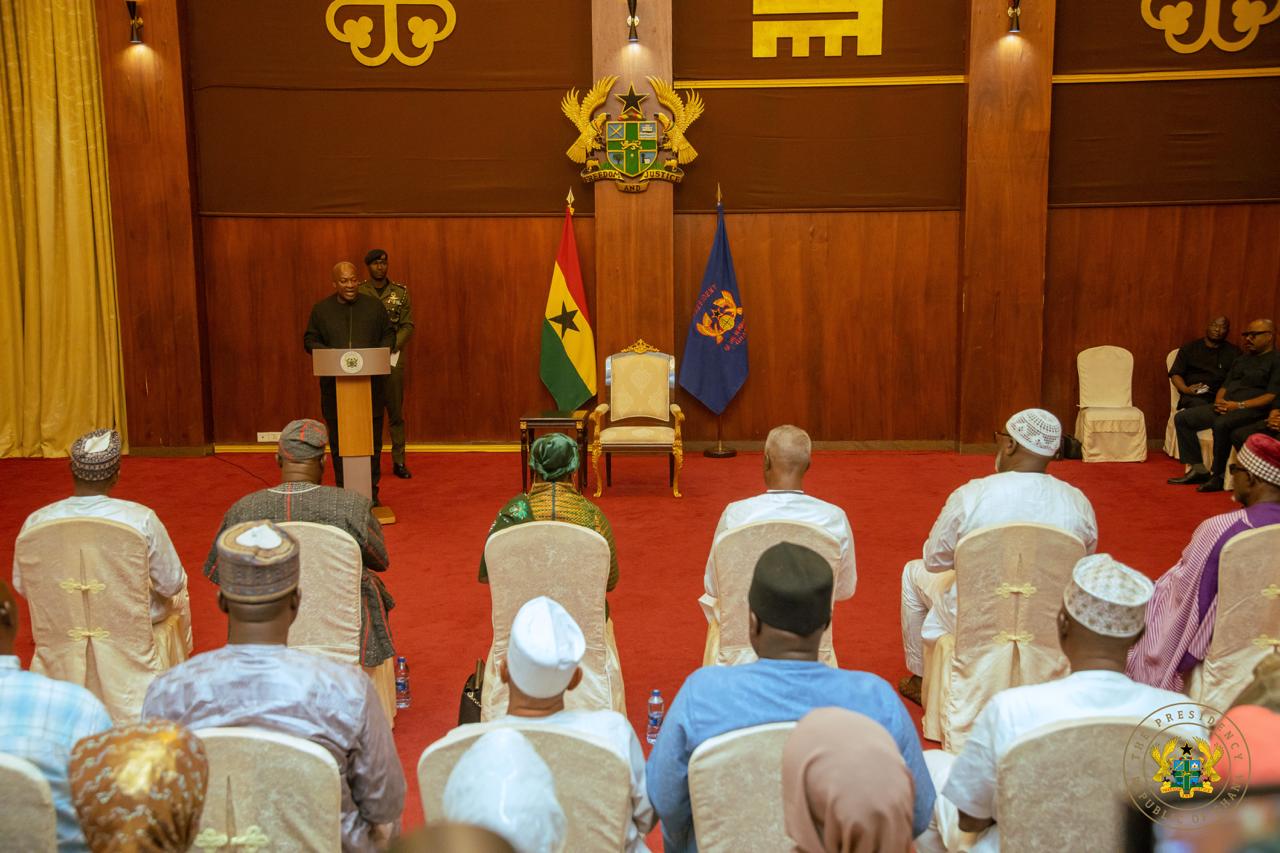
Speaking at the swearing-in ceremony of the new Hajj Board at the Presidency, President Mahama explained that periodic reporting is required to sustain public confidence and ensure that future boards inherit reliable institutional memory.
“At the end of each Hajj season, I expect a comprehensive report that covers the finances, logistics, health, and safety outcomes, and the lessons learned to be presented to the Chief of Staff for preparation for the following year. This transparency will not only sustain public confidence, but also ensure that future boards inherit reliable institutional memory,” he said.
The President emphasized that the Hajj Board must operate under clear guidelines, with periodic reporting to the Office of the Chief of Staff.
He stated that government will provide the necessary policy and logistical support to ensure the success of the pilgrimage, but that support must go hand in hand with accountability.
President Mahama called for early and predictable planning by the Hajj Board, urging members to begin preparations immediately for the next Hajj.
He directed the Board to announce schedules, registration processes, and cost structures promptly for pilgrims and agents so they can plan effectively.
“Last-minute changes must become a thing of the past. Begin preparations immediately for the next Hajj. Announce schedules, registration processes, and cost structures promptly for pilgrims and agents so they can plan effectively,” President Mahama stated.
He noted that over the years, Ghana’s Hajj operations have witnessed seasons of smooth organization and others that have tested patience and systems, adding that each experience has taught valuable lessons about the importance of early planning, inter-agency coordination, and financial discipline.
The President declared that the Hajj belongs to the entire Muslim community across Ghana and is not a monopoly of any one group.
He stated that from the Zongos of Accra to Tamale, from Wa to Bolga, from Koforidua to Takoradi, the Hajj belongs to the whole of Ghana.
“Ensure that registration and access are fair and balanced across all our regions. Engage traditional leaders and regional imams so that every community feels represented and heard in the process of the Hajj. Inclusivity strengthens unity, and unity ensures peace,” President Mahama said.
He urged the Board to engage traditional leaders and regional imams to ensure that every community feels represented and heard in the Hajj process.
President Mahama called for special attention to be paid to elderly pilgrims, women, and persons with disabilities during the Hajj operations.
He directed the Board to coordinate with the Ghana Health Service, the Ministry of Transport, and Ghana’s Embassy in Riyadh to guarantee safe travel, decent accommodation, adequate meals and efficient medical support.
“Pay special attention to elderly pilgrims, women, and persons with disabilities. Their comfort is also a sacred duty of the Hajj Board,” the President stated.
He described the comfort of vulnerable pilgrims as a sacred duty of the Hajj Board, emphasizing that safety, health, and welfare must be priorities.
President Mahama noted that every official from Board members to volunteers must act with courtesy, discipline, fairness, and honesty, adding that pilgrims should feel respected at every point, from registration to their safe return home.
He emphasized that the Hajj Board is more than just an administrative body, stating that it is an institution that ensures thousands of Ghanaian pilgrims fulfill one of the highest pillars of Islam with dignity and peace every year.
The President stated that managing Hajj is not just a routine exercise but a sacred public trust that requires competence, transparency, and compassion in equal measure.
Richard Aniagyei, ISD