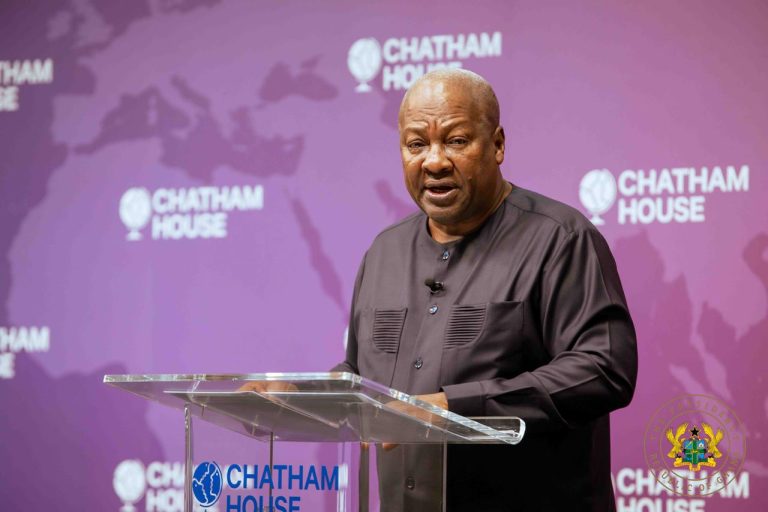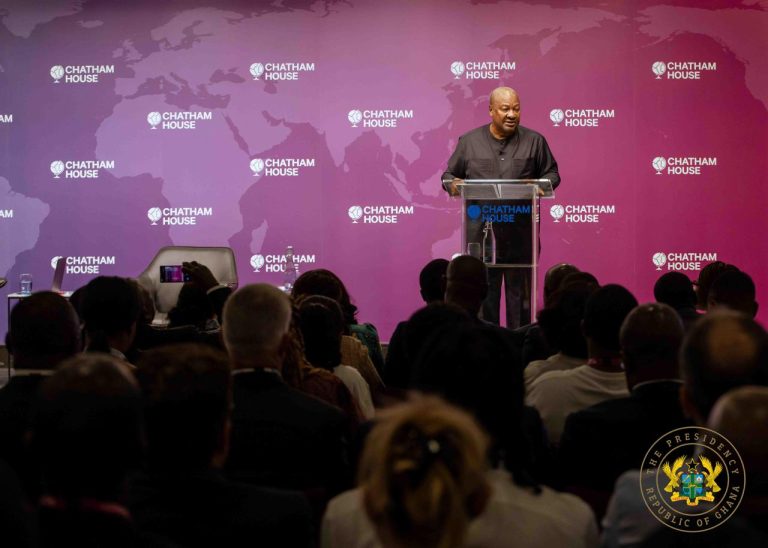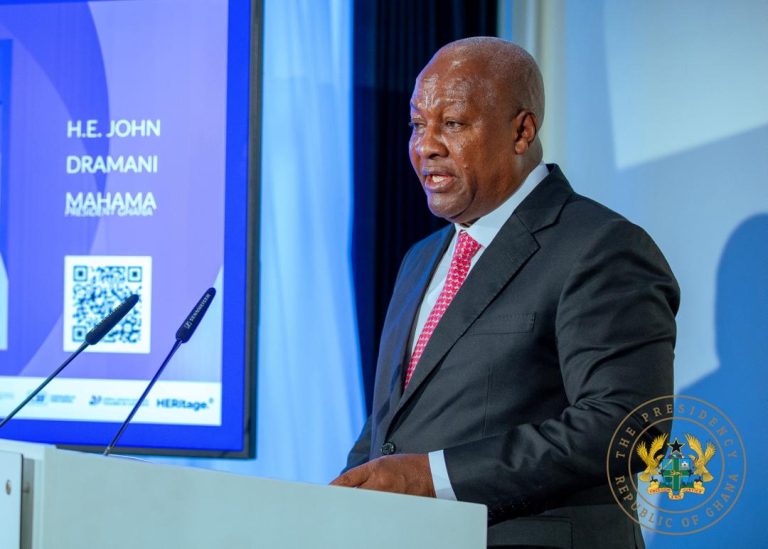
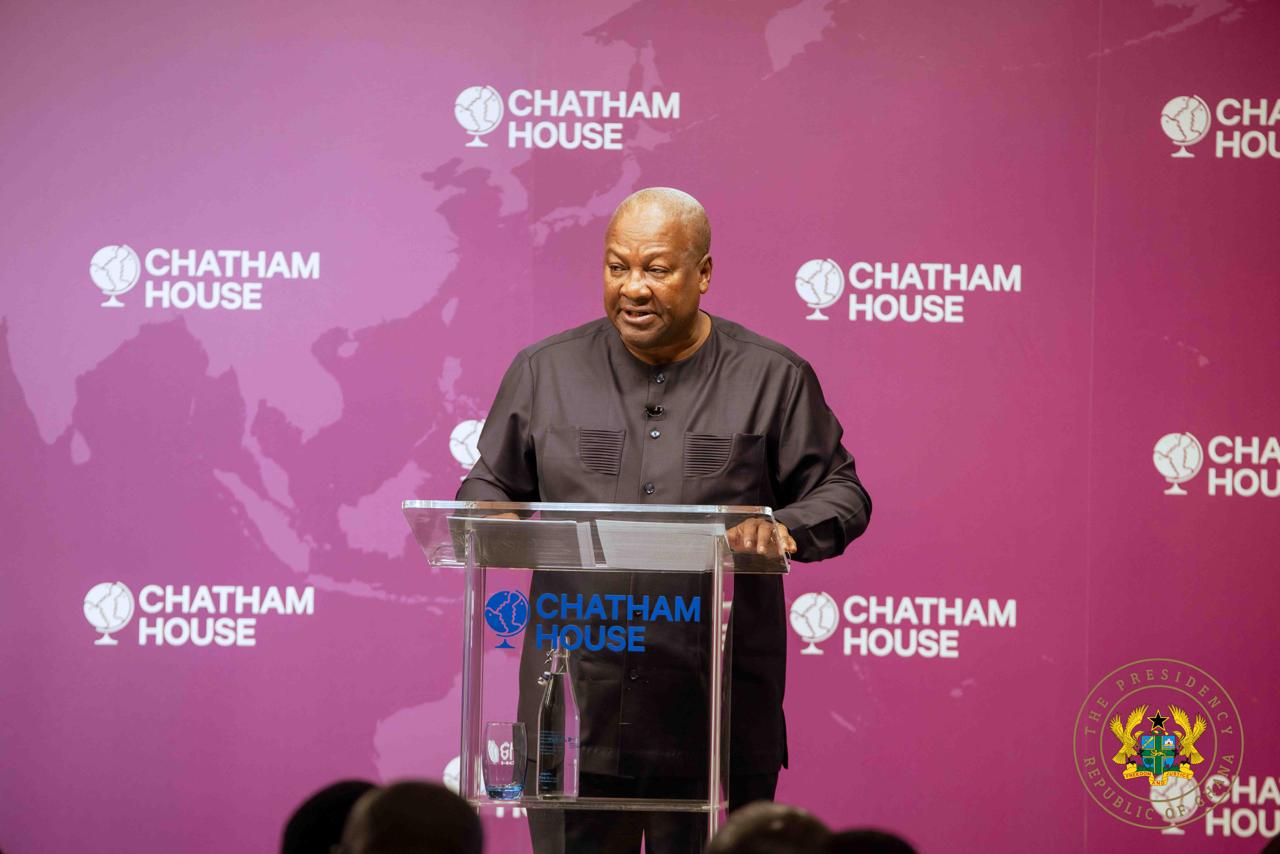
The post-war multilateral system is under severe strain, and countries in the Global South can no longer afford to wait passively for the world to sort itself out.
President John Dramani Mahama said during his address at Chatham House in London on Monday.
President Mahama said geopolitical competition was intensifying, economic nationalism was resurging, multilateral institutions were weakening, and technological disruption was reshaping power and production, all at the same time.
Climate change, he added, was deepening global vulnerabilities that the international system was increasingly ill-equipped to handle.
“The global order at the end of the Second World War is undergoing a significant transformation,
“History reminds us that no global order is permanent,” he added.
He traced the arc of rising and falling powers from the ancient empires of Babylon, Persia, Rome, and Mongolia through to the European colonial era and the post-1945 Atlantic order, noting that London itself sat at the centre of that history.
“The British Empire was once described as the empire on which the sun never sets, Yet history evolved, power shifted, new centres of influence emerged, and the global system adjusted accordingly,” he noted.
What concerned him, he said, was not change itself but how nations responded to it.
The post-1945 order, despite its imperfections, had established important norms around sovereign equality, territorial integrity, and the peaceful settlement of disputes, norms that many formerly colonised nations, including Ghana, had relied upon to secure their independence.
Today, the President said, many of those norms were being eroded through the selective application of international law and the growing tendency for strategic competition to take precedence over collective responsibility.
For Ghana, President Mahama said the moment demanded purposeful engagement built around four strategic priorities: reforming global governance, leading African integration, building balanced and mutually beneficial partnerships, and strengthening sovereign control over its own development path.
He pointed to the African Continental Free Trade Area, headquartered in Accra, as one of the most consequential economic transformation projects of the current generation, arguing that African unity was no longer simply a political aspiration but a strategic imperative in a world marked by supply chain fragmentation and rising economic nationalism.
“In today’s global environment, no African country, regardless of size or resources, can effectively navigate geopolitical and economic complexities in isolation,” he said.
On the domestic front, President Mahama said Ghana’s democratic tradition remained one of its greatest strategic assets at a time when democratic systems were under pressure across the world.
He described democracy not merely as a political ideal but as an economic asset that strengthened investor confidence, supported social cohesion, and created the predictability needed for long-term investment.
“The future of the international system will not be shaped solely by military power or economic scale,” he said. “The quality of leadership, the credibility of institutions, the fairness of partnerships, and the ability of nations to build trust across divides will also shape it.”
Richard Aniagyei, ISD