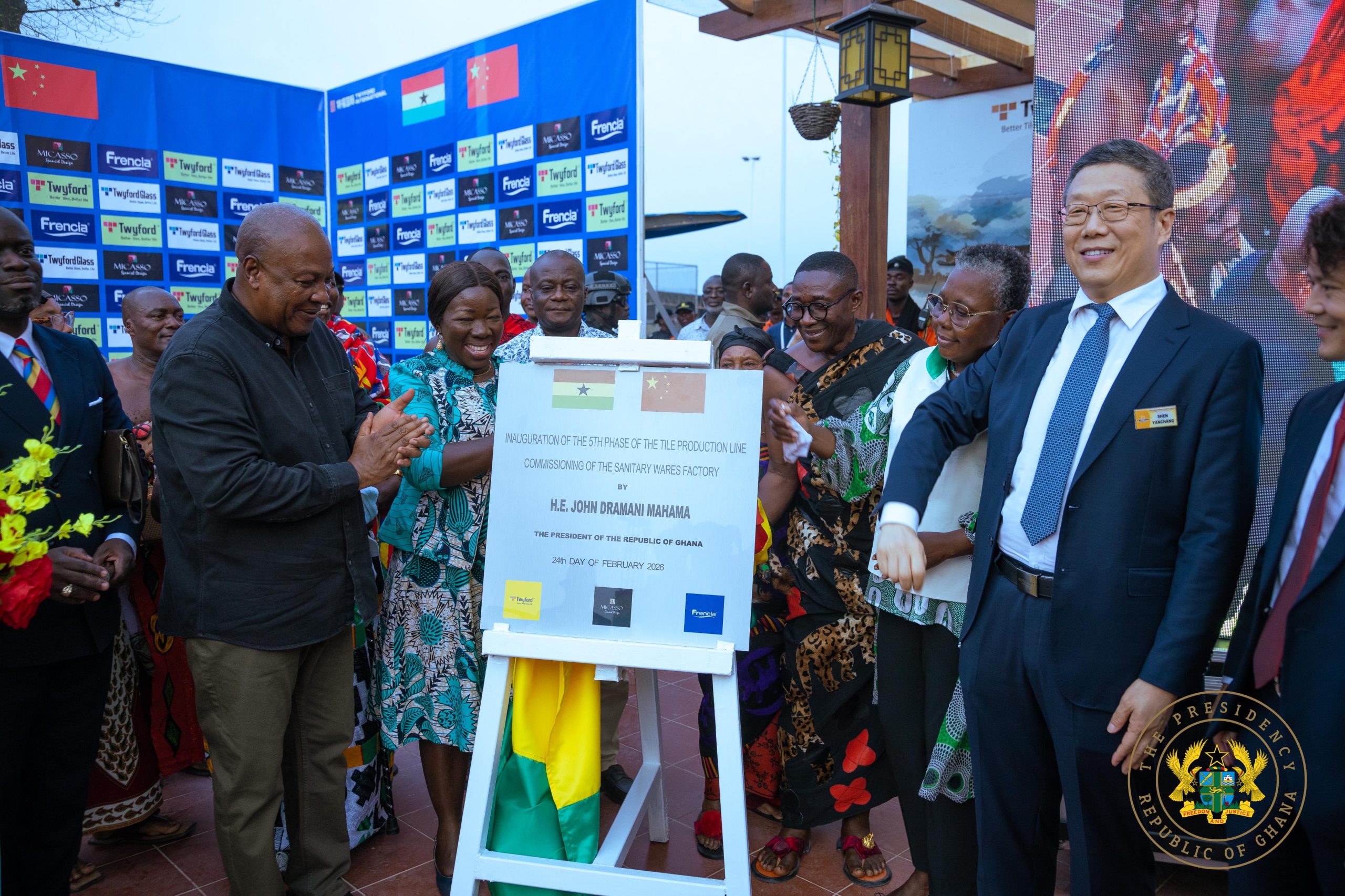
President John Dramani Mahama has cut sod for the construction of a $250 million float glass manufacturing facility at KEDA Ghana Ceramics Company Limited in Shama, Western Region.
The President performed the sod-cutting on Tuesday, describing the project as one of the largest industrial investments in Ghana’s history and a game changer for the country’s glass industry.
He disclosed that the facility will be implemented in two phases, with Phase 1 establishing a capacity of 600 tons per day and Phase 2 adding another 800 tons per day, bringing total capacity to 1,400 tons daily.
“Phase 1 of the float glass factory will establish a capacity of 600 tons per day. Phase 2 will add another 800 tons per day, bringing total capacity to 1,400 tons daily,” President Mahama stated.
He announced that Phase 1 will be commissioned in August 2027, with sod-cutting for Phase 2 taking place at the same ceremony.
The President explained that when completed, the facility will be one of the largest float glass facilities in Africa, producing glass for export to other African countries, Europe, and other destinations.
President Mahama revealed that in 2024 alone, Ghana imported over 65,000 tons of glass products valued at almost $25 million to meet the demand of the construction industry, automobile, and manufacturing sectors.
“If you imagine that every piece of glass you see in this country, from our drinking glasses, to our windows, to our beer bottles, every single piece of glass you see in this country is imported from outside. And so this is going to be a game changer in terms of glass production,” the President said.
He announced that the factory will change the equation by reducing imports of glass, saving foreign exchange, strengthening supply chain reliability, and positioning Ghana as a major regional exporter of glass.
President Mahama disclosed that at full capacity, when the factory is producing 1,400 tons per day, export earnings alone are projected to be almost $100 million annually.
He stated that the global float glass market is valued at approximately $60 billion annually and Ghana must not remain on the margins of this industry.
The President explained that the float glass facility will consume over 700 tons of raw material daily, reflecting its scale and industrial sophistication.
He commended KEDA for integrating responsible environmental practices into the development, noting that industrial growth must be green, efficient, and forward-looking.
President Mahama recounted how during his visit to China in October at the invitation of President Xi Jinping, Chairman Shen of KEDA informed him about plans to list on the Hong Kong Stock Exchange and promised to build a glass factory for Ghana if the listing succeeded.
“And he told me, if we list successfully, I’m going to come and build a glass factory for you. And I said, the last time I heard about a glass factory was Aboso Glass Factory. Are you coming to take over Aboso Glass Factory? Again, he told me, no. We’re building a brand new glass factory,” President Mahama recalled.
He stated that less than a year after that meeting in China, the country has gathered to cut sod for the $250 million float glass factory.
The President disclosed that the project will generate approximately 2,182 direct jobs, with 729 people employed during construction and 1,453 permanent operational jobs created.
He announced that beyond direct employment, thousands of indirect jobs will be created through logistics, supplies, raw material supplies, services, and maintenance.
President Mahama stated that the investment includes a structured localization and skills transfer program where Ghanaian engineers, technicians, and managers will receive training to assume leadership roles progressively.
“This is how we move from labor participation to labor ownership,” the President said.
He revealed that KEDA contributed GH¢740 million in taxes in 2025 alone and projected that at full production from August 2027, tax revenue from the company will exceed GH¢1 billion annually.
The President thanked the traditional rulers of Shama for granting a leasehold of almost 800 acres for the ceramic tile factory, sanitary ware factory, and float glass factory.
He noted that the area is becoming the industrial hub of the Western Region, with 60% of production from these factories being exported to neighboring countries and other destinations.
President Mahama announced that he had recently signed the 24-Hour Economy Authority Bill into law and proposed that factories registered under the initiative should be able to bring equipment for expansion or retooling duty and tax-free.
He declared that the sod-cutting symbolizes more than just the beginning of construction but represents Ghana’s industrial resurgence, export ambition, and belief in her own productive power.
Richard Aniagyei,ISD