Ghana has reclaimed its position as the second largest economy in West Africa with a Gross Domestic Product exceeding $100 billion, overtaking Côte d’Ivoire which had held the position since 2022.
The country’s GDP is now estimated at $113 billion, representing a substantial increase from around $75 billion previously and positioning Ghana as the seventh largest economy in Africa.
The economy expanded by 5.5% in the third quarter of 2025, the strongest performance since 2020, driven by improved macroeconomic stability and restored investor confidence.
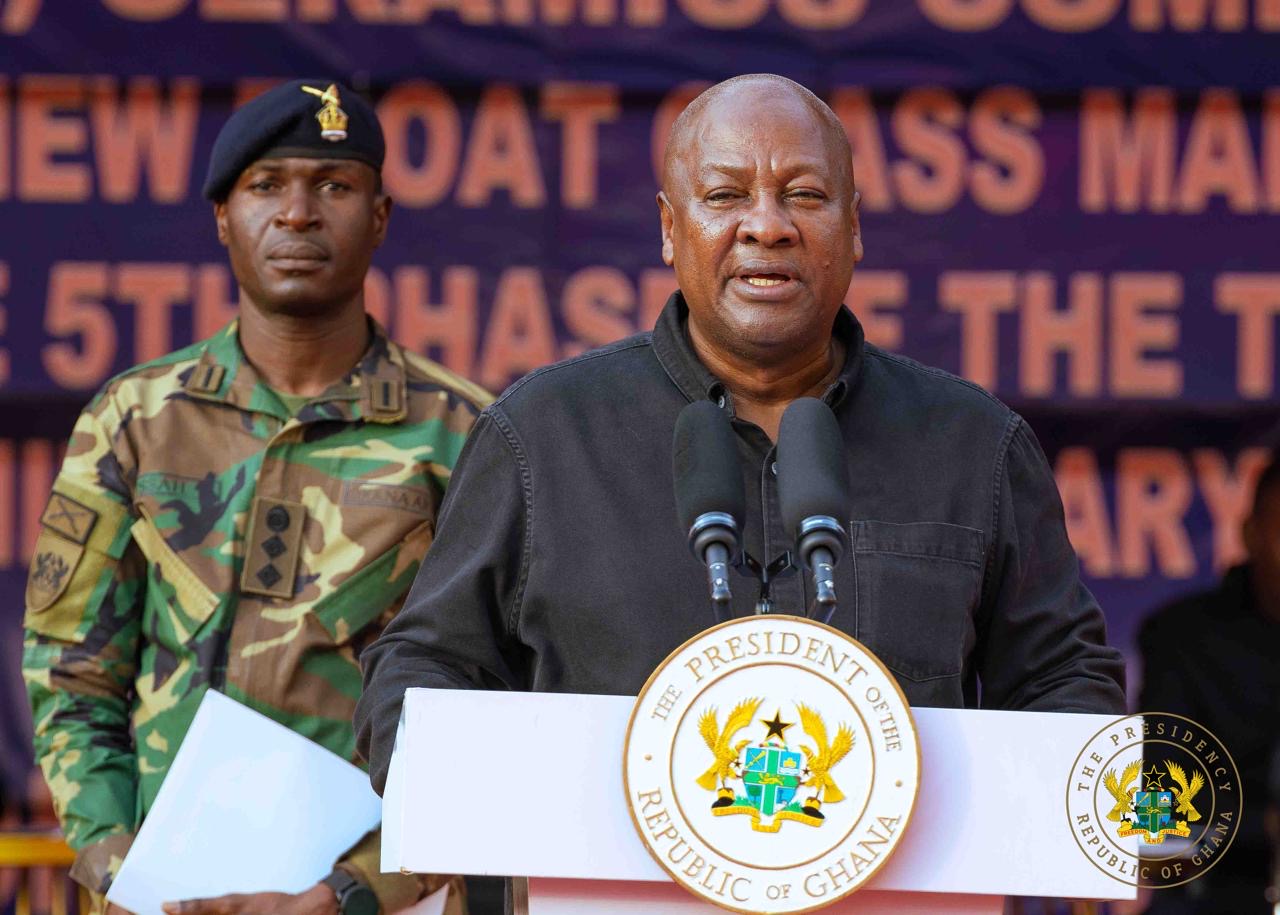
President John Dramani Mahama announced this on Tuesday at KEDA Ghana Ceramics Company Limited in Shama, Western Region, during the sod-cutting for a $250 million float glass manufacturing facility.
“In the recent rankings of African economies, Ghana positioned as the seventh largest economy in Africa. And I’m pleased to announce that we have also overtaken Côte d’Ivoire as the second largest economy in West Africa,” President Mahama stated.
He explained that in 2022, an event that most Ghanaians did not notice occurred when Côte d’Ivoire overtook Ghana as the second largest economy in West Africa.
The President noted that Nigeria has always been the first, with a GDP of about $300 billion, and Ghana had followed with a GDP of around $75 billion before losing the second position.
“Today, Ghana’s GDP has exceeded the $100 billion mark. It’s estimated at $113 billion. And it has earned us our second position again in front of our Côte d’Ivoire brothers,” President Mahama said.
He disclosed that inflation has declined dramatically from 23.5% in January 2025 to 3.8% in January 2026, reflecting the success of the government’s economic reset agenda.
The President announced that the fiscal consolidation program has restored international credibility, reflected in sovereign rating upgrades by all major rating agencies including Fitch, Moody’s, and S&P.
“These are not just abstract statistics, they are signals. Signals to investors, both local and foreign, that Ghana is stable, predictable, and open for business,” President Mahama stated.
He explained that just over a year ago, the nation stood at a crossroads with the manufacturing base under strain, foreign investment dwindled to a trickle, investor confidence weakened, and the currency declining in value.
The President noted that early in 2025, many questioned, including himself, whether the country would be able to make a swift turnaround or whether it would take years to rebuild stability and confidence.
“Today, I’m pleased to announce that the story is different. Through our RESET agenda, we have restored macroeconomic stability, we have revived investor confidence, and we’ve repositioned Ghana as a serious destination for productive investment,” President Mahama said.
He emphasized that the economic turnaround is visible in concrete, steel, and machinery, pointing to the $250 million float glass factory, fifth phase tile production line, and sanitary ware factory being commissioned at KEDA.
The President stated that the GDP milestone is not merely a statistic but evidence that Ghana is no longer content to be a consumer and import economy but is determined to produce, process, manufacture, and export.
He noted that production underpins the value of currency, not speculation, and that building a strong economy requires manufacturing strength backed by exports.
President Mahama attributed the economic recovery to the government’s commitment to maintaining stable macroeconomic policy, providing regulatory clarity, implementing industrial financing reform, enforcing fair trade, and improving infrastructure.
He called on the private sector to invest and scale up domestic production, create additional Ghanaian jobs, prioritize local content, invest in skills development, and maintain international standards for products.
The President declared that Ghana’s industrial resurgence is not a distant ambition or dream but a reality happening today, as evidenced by major investments like the KEDA expansion.
Richard Aniagyei, ISD