
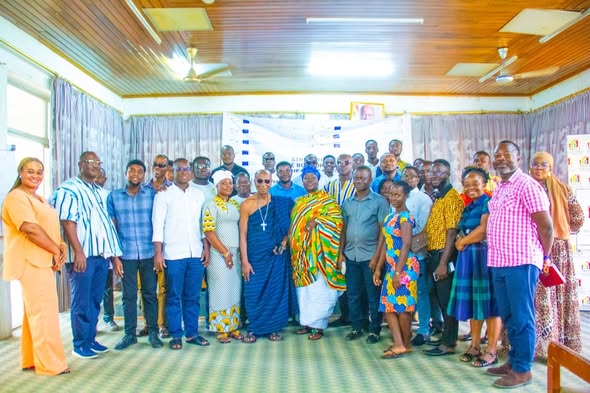
The Obuasi Municipal Office of the National Commission for Civic Education (NCCE) has organised a stakeholder workshop on social auditing, aimed at strengthening citizen participation and promoting accountability in local governance.
The workshop sought to empower citizens to hold public officials accountable while encouraging them to take an active interest in the affairs of the state. According to the Commission, the essence of social auditing is to ensure that duty bearers are held responsible for their actions and decisions, particularly in matters relating to community development and public resource management.
Speaking on the theme “Strengthening the Rule of Law and the Fight Against Corruption in Ghana,” the Ashanti Sub-Regional Director of the Commission on Human Rights and Administrative Justice (CHRAJ), Mr Samuel Owusu Asante, emphasised the importance of citizen awareness and respect for the laws of the land. He explained that the rule of law stands in direct contrast to the rule of man, underscoring that governance must be guided by established laws rather than individual discretion.
Mr Asante noted that when citizens are well-informed about their rights and responsibilities, the rule of law thrives. However, he cautioned that ignorance of the law does not excuse wrongdoing. He further clarified some fundamental legal principles to address common misconceptions. Among them, he explained that all offences are bailable under Ghanaian law and that citizens are not required to pay money to secure bail for a suspect. Touching on conflict of interest, he advised that such matters should be formally reported to CHRAJ for appropriate investigation and action.
Addressing participants, the Municipal Director of the NCCE, Mr Lawrence Nyame, urged citizens to move from passive observation to active engagement in national and local governance issues. He led discussions on several key thematic areas, including access to quality education, health services and facilities, local economic development and employment opportunities, agriculture and access to agricultural support, infrastructure and public utilities, corruption and transparency in public projects, youth development and participation, as well as the welfare of women and children.
The Director stimulated robust engagement among participants, encouraging them to see social auditing not as confrontation but as constructive civic responsibility aimed at improving governance outcomes.
Mr Nyame also outlined the various communication channels the NCCE employs to reach the public. These include one-on-one engagements, radio programmes, information centre outreach, and visits to churches and mosques. He assured stakeholders that these platforms would be strengthened in the coming year to deepen civic education and broaden public participation.
Participants at the workshop resolved to become more active citizens in their communities, pledging to demand greater transparency and accountability from duty bearers. They also called for increased funding support for the NCCE to enable the Commission to expand such impactful civic engagement initiatives.
The programme was sponsored by GIZ, whose support continues to enhance civic awareness and participatory governance at the local level.
Ernest Kofi Offen, ISD