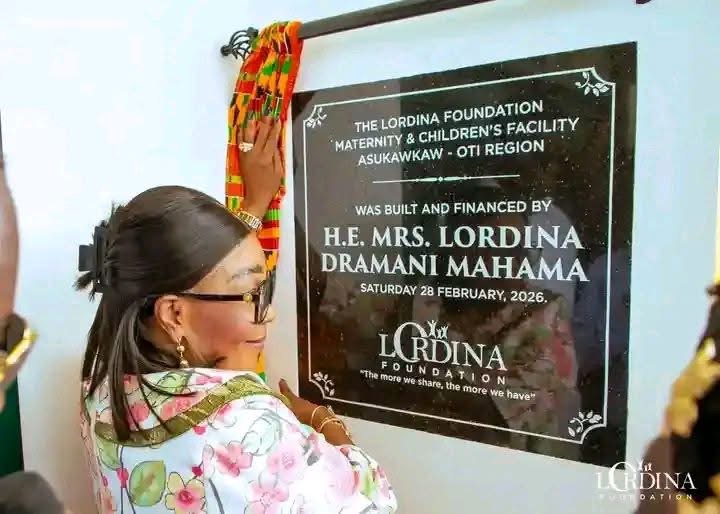
The Lordina Foundation has commissioned a fully equipped ultramodern maternity and children’s ward at the Asukawkaw Clinic in the Krachi East District of the Oti Region.
The foundation had previously built facilities in Bole, Nkroansa, and Bodom, while also renovating and expanding the Hohoe Adabraka Clinic.
First Lady Mrs. Lordina Dramani Mahama who commissioned this facility on Sunday revealed that the facility is the fourth modern health facility completed by the Lordina Foundation.
“The first was in Bole, the second in Nkroansa, the third in Bodom, and now Asukawkaw. We have also renovated and expanded the Hokoi Adabraka Clinic,” Mrs. Mahama stated.
She explained that each facility reflects the foundation’s belief that no woman should die while giving birth and that no child should begin life without proper care simply because of where they were born.
The First Lady disclosed that the project was initiated after she received a brief but urgent email appeal from Nana Odam Gyamfi III on a Sunday evening, requesting help to build a modern maternity and children’s ward in Asukawkaw.
She said the message conveyed a heavy story of women in the community traveling dangerous distances for medical care, with pregnant mothers carried on trucks over poor roads, arriving at distant facilities too late to save lives.
“At the time we received the email, the Lordina Foundation was planning to expand health infrastructure in underserved communities, particularly in the newly created region,” Mrs. Mahama said.
She noted that a recent report found that nearly one in ten Ghanaian women still face the risk of dying from pregnancy-related causes, a reality the women of Asukawkaw lived with every day.
The First Lady stated that the foundation immediately deployed its team, identified land, and drew up plans to address the urgent need.
Mrs. Mahama disclosed that the new facility has been carefully designed to serve mothers and children with dignity and excellence, including a reception and waiting area, a doctor’s office, nurses’ offices, a children’s ward and maternity ward, a fully equipped operating theater, a delivery room, a sterilization room, and a neonatal intensive care unit.
She revealed that the ward is equipped with essential life-saving equipment including electric beds, operating tables, infant incubators, ultrasound systems, caesarean and delivery sets, ECG machines, phototherapy machines, patient monitors, and oxygen support systems.
The First Lady announced that the maternity ward is equipped with solar panels to provide emergency lighting and reduce electricity use, while furniture, waiting chairs, desks, cabinets, bedding, and cleaning supplies have been provided to ensure the facility is ready to serve from day one.
She called on health authorities, management teams, and the entire community to protect the facility, maintain it well, use it wisely, and let it serve the current generation and many generations to come.
“Across our nation, we have had breaking stories of life lost due to a lack of hospital beds, poor maintenance, and systems that failed when they were needed most. We cannot allow that to happen here,” Mrs. Mahama said.
The First Lady emphasized that the Lordina Foundation believes that when a mother is safe, a nation is strong, and when a girl has access to healthcare, her future becomes limitless.
She stated that the foundation’s humanitarian mission remains clear: to make primary healthcare accessible to women, girls, and the elderly.
Mrs. Mahama announced that this year and beyond, the foundation will continue to invest not only in facilities but also in resilient health systems.
She expressed gratitude to partners including LAG, MEC Foundation, and many others who share the vision of a healthier, more caring world.
The First Lady thanked Nana Odam Jesse III and the Krachi East Traditional Council for entrusting the vision to the foundation, as well as partners, health workers, the construction team, and the people of Asukawkaw for believing change is possible.
She declared that the facility should be more than a building but a reminder that together with governments, traditional leaders, health workers, development partners, and communities, Ghana can be built where every woman, child, and vulnerable person is protected and supported.
Richard Aniagyei, ISD