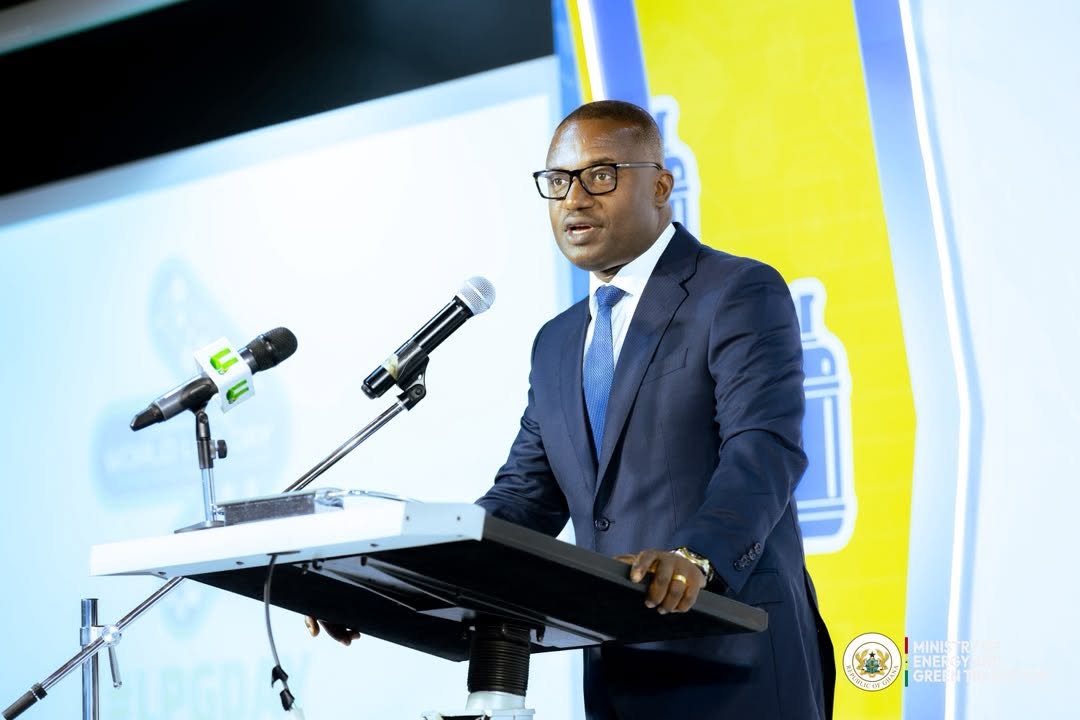
The Minister for Energy and Green Transition, Dr John Abdulai Jinapor, has announced that the government has mobilised six million dollars towards the retooling of the Ghana Cylinder Manufacturing Company Limited (GCMC), bringing the country closer to its goal of expanding local cylinder production.
He made the announcement on Monday at the National LPG Forum organised by the National Petroleum Authority (NPA) in Accra
Dr Jinapor said the amount represents three-quarters of the estimated $8 million required for the project.
He explained that the retooling programme would strengthen local manufacturing capacity, support plans to phase out imported cylinders and create employment opportunities within the sector.
He said the initiative forms part of broader efforts to accelerate the adoption of Liquefied Petroleum Gas (LPG) as a cleaner cooking fuel and reduce dependence on firewood and charcoal.
According to him, increasing the use of LPG remains a key objective under Ghana’s National Energy Transition Framework. National LPG penetration is currently estimated at 43 per cent, with the government targeting at least 50 per cent adoption by 2030.
Dr Jinapor described LPG as one of the most environmentally friendly and readily accessible cooking solutions, noting that greater use of the fuel would help protect forests, improve respiratory health and reduce carbon emissions.
He said the government was addressing accessibility and safety concerns through the Cylinder Recirculation Model (CRM), which allows consumers to exchange empty cylinders for safely pre-filled ones at designated distribution points.
Investments in commercial cylinder recirculation plants in Tema and Kumasi have increased local filling capacity to more than 12,800 cylinders per day.
The minister further disclosed that under the Liquefied Petroleum Gas for Development initiative, the government and its development partners plan to distribute two million domestic cookstoves and 200,000 commercial-sized stoves to first-time users by 2030.
Despite progress in the sector, the Chamber of Oil Marketing Companies (COMAC) has identified retail pricing and sector taxes as challenges affecting LPG uptake, particularly among lower-income households.
Responding to those concerns, Dr Jinapor said the ministry was reviewing fiscal measures to balance affordability with the need to sustain investments in LPG infrastructure.
He added that the government would continue to expand distribution networks, establish localised distribution points and supply free starter kits to rural communities to encourage wider adoption.
Dr Jinapor said Ghana’s approach to clean cooking and energy transition offers a practical model for other countries in West Africa seeking environmentally sustainable and economically viable solutions.
Irene Wirekoaa Osei, ISD