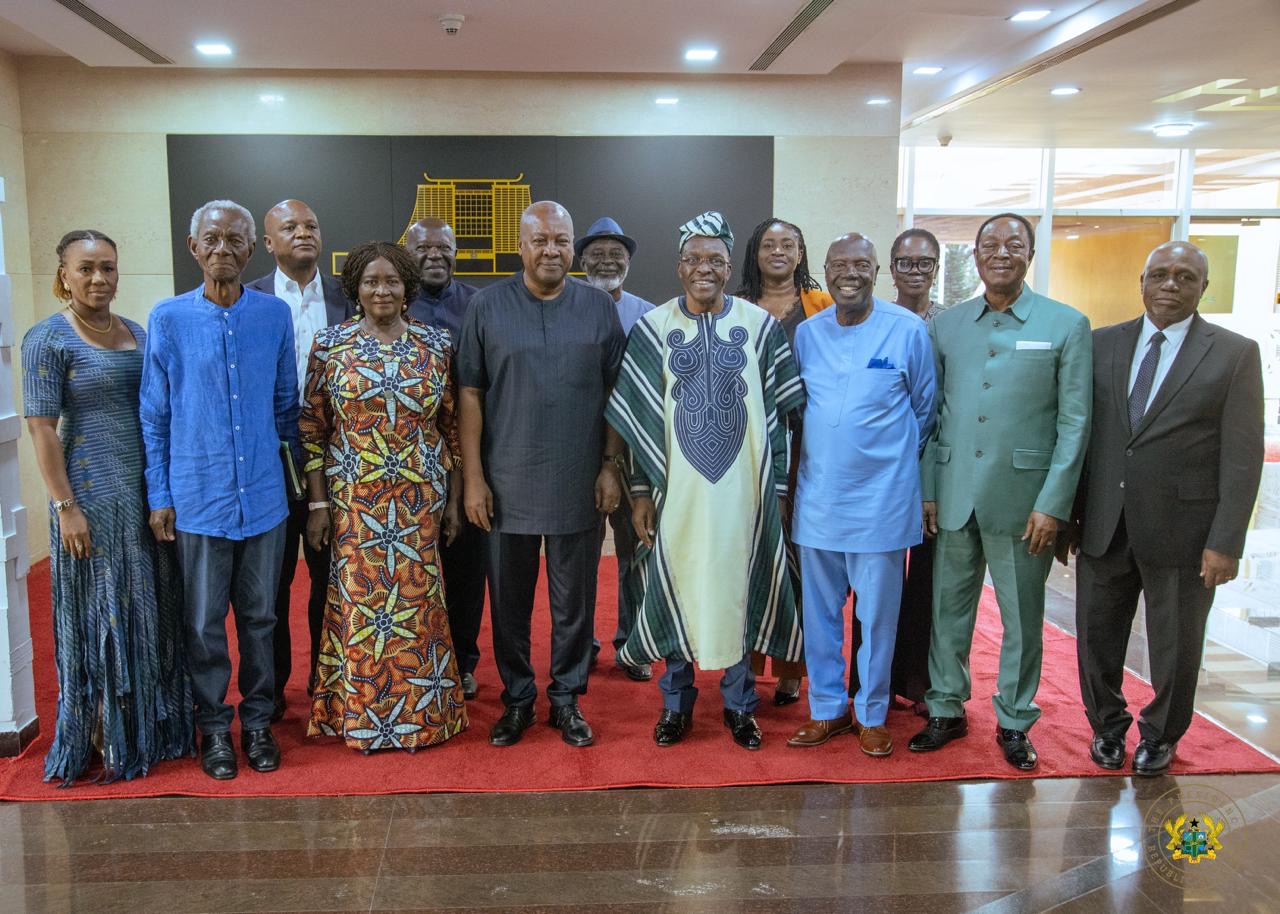
President John Dramani Mahama has inaugurated a 12-member Presidential Advisory Group on the Economy (PAGE), marking the return of the economic advisory structure that existed under the late President John Evans Atta Mills and during his earlier tenure in office.
The inauguration eliminates the Economic Management Team structure, streamlining economic governance under the new configuration that will report directly to the President on macroeconomic management, fiscal consolidation, debt sustainability, and industrial development strategies.
During the inauguration of PAGE at the Jubilee House in Accra, the President outlined the group’s mandate and composition.
Vice President Prof. Jane Naana Opoku-Agyemang will chair PAGE meetings in the President’s absence, in accordance with constitutional responsibility.
The group is expected to meet at least once every quarter, with provisions for emergency meetings as circumstances demand.
“PAGE will meet at least once every quarter, but will also meet in circumstances of emergency. There will be emergency meetings,” President Mahama stated.
The 12-member group brings together expertise spanning fiscal policy, monetary management, capital markets, private enterprise, academia, and the real economy. Five of the members are women, reflecting what the President described as strategic gender and generational balance.
Members of PAGE are Vice President Prof. Jane Naana Opoku-Agyemang, Mr. Ishmael Yamson, Mr. Kwame Pianim, Ms. Nana Oye Mensa Yeboaa, Dr. Kwabena Duffuor, Sir Samuel Esson Jonah, Mr. Ato Brown, Dr. Henry A. Kofi Wampah, Togbe Afede XIV, Ms. Abena Amoah, Prof. Priscilla Twumasi Baffour, and Prof. Patience Aseweh Abor.
Several members, including Mr. Yamson and Mr. Pianim, served on PAGE during President Mahama’s earlier administration, bringing institutional memory and continuity to the group.
According to the President, PAGE is mandated to provide strategic counsel on macroeconomic management, fiscal consolidation, debt sustainability, and coherence between fiscal and monetary policy. The group will also advise on structural transformation, industrial development, competitiveness, and export-led growth strategies.
PAGE is charged with offering guidance on sectoral development, private sector expansion, investment mobilization, and sustainable job creation while supporting the design and implementation of flagship national initiatives, including the 24-hour economy and the accelerated export development program.
“You are to advise on structural transformation, industrial development, competitiveness, and export-led growth strategies,” President Mahama told the members.
The group will conduct periodic assessments of Ghana’s economic performance, propose policy adjustments where necessary, and contribute expert input to Ghana’s economic negotiations with bilateral and multilateral partners, international financial institutions, and investors.
PAGE will operate alongside the Economic Policy Coordinating Committee (EPCC), which is jointly chaired by the Minister for Finance and the Governor of the Bank of Ghana. The President encouraged continued coordination between the two bodies to achieve efficiency, coherence, and cost-effective governance.
The Minister of Finance, the Governor of the Bank of Ghana, the Special Advisor to the President, and the Chairman of the National Development Planning Commission (NDPC) will provide technical support to PAGE’s work.
In his address, President Mahama painted a candid picture of the economic challenges facing the nation, acknowledging that Ghana finds itself in debt distress again despite previous HIPC declaration and assurances never to return to such a position.
“As a nation, we find ourselves again in debt distress after having previously declared HIPC and solemnly assuring ourselves that we will never return to such a position,” he stated.
The President noted that the country dissipated substantial buffers and stabilizers that would have shielded citizens from painful domestic debt haircuts. He also pointed to policy inconsistency in the petroleum sector, which has driven investors to competing jurisdictions, resulting in declining crude oil output.
“After investing in three oil fields and positioning ourselves as an emerging petroleum economy, we allow policy inconsistency and investor uncertainty to drive existing and potential investors to competing jurisdictions,” President Mahama observed.
He emphasized that PAGE’s counsel must help rebuild credibility, restore fiscal discipline, attract investment, re-anchor expectations, and re-establish Ghana as a serious, predictable, and competitive economy.
“This is not simply about recovery. It is about institutional reform, structural transformation, and a permanent reset of our economic governance culture,” the President declared.
President Mahama told PAGE members their advice will be sought on major economic milestones, including the national budget, mid-year reviews, monetary policy developments, medium-term plans, and other strategic initiatives.
He expressed expectations for rigorous analysis, constructive disagreements and agreements, and solutions that place Ghana firmly on a path of economic recovery, resilience, and inclusive growth.
“Your counsel is therefore expected to be frank, independent, evidence-based, and anchored in the long-term national interest,” President Mahama said.
The President thanked the members for accepting the call to serve at what he described as a critical moment in Ghana’s economic journey, noting that their willingness to contribute reflects a deep commitment to public service and the future of the republic.
Richard Aniagyei, ISD