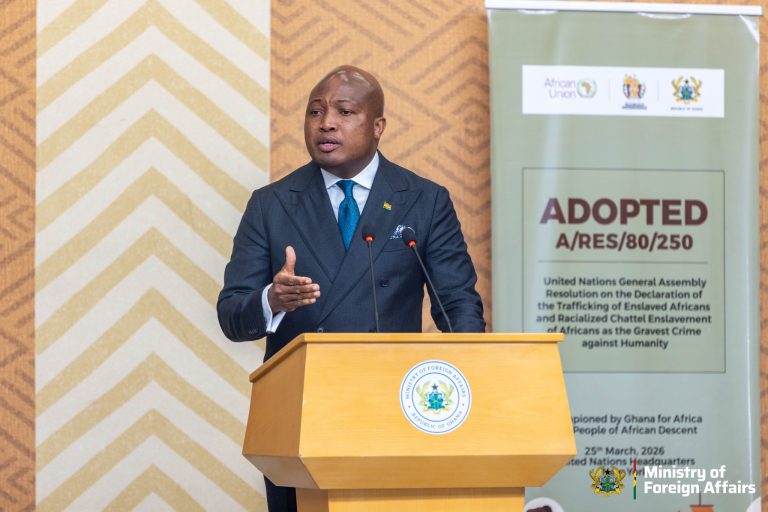
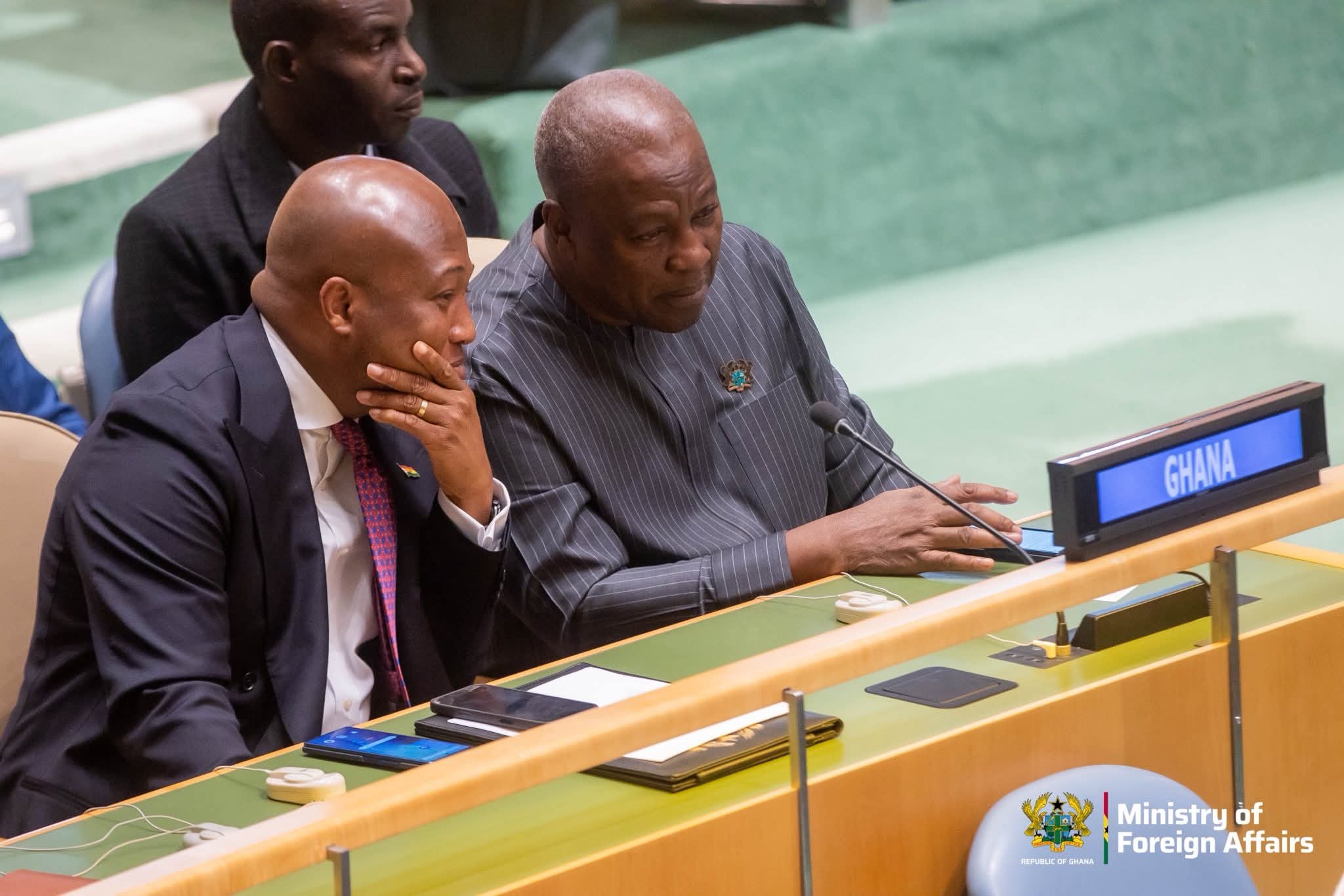
President John Dramani Mahama has commended Minister for Foreign Affairs Samuel Okudzeto Ablakwa for his leadership in guiding Ghana to secure the adoption of a United Nations General Assembly resolution on the transatlantic slave trade.
The President said the outcome was achieved despite strong last-minute pressure from some countries to delay the vote over concerns about support.
“When I gave notice of this motion, I did not delude myself that it was always going to be a difficult task. We needed to build a broad coalition to get this through,” he said.
He explained that several countries, including some expected to support the resolution, called for a postponement and further revisions to the text.
President Mahama said he consulted the Foreign Minister on the eve of the vote amid concerns that the numbers might not be sufficient, but Mr Ablakwa advised against any delay.
He said that if the resolution had been postponed, it was uncertain when such an opportunity would arise again, adding that they had built the strongest coalition possible and had to move forward.
The President said Ghana proceeded with the vote based on what he described as a broad cross-regional alliance, which led to what he called an emphatic victory at the General Assembly.
The resolution recognises the transatlantic slave trade and its legacy as a grave crime against humanity. Ghana has been advocating for this recognition as part of a wider agenda on reparatory justice and historical accountability.
“This victory belongs to all of us but most importantly to those who were meant to be forgotten. Today, the United Nations has recorded that this was among the gravest crimes against humanity,” he said.
The resolution received support from 123 countries, while the United States, Israel and Argentina voted against it, and 52 European countries, together with the United Kingdom, abstained.
Interacting with the media, Mr Ablakwa said countries that voted against or abstained had missed an opportunity to acknowledge historical injustices, but noted that engagement would continue.
“Ghana’s approach involved consultations with legal experts, historians and policymakers to refine the resolution while maintaining its core objective,” he noted.
Mr Ablakwa expressed appreciation to the countries that supported the resolution, stating that they had aligned on the right side of history.
The adoption of the resolution is expected to strengthen Ghana’s role in global discussions on reparatory justice across Africa, the Caribbean and Latin America, while reinforcing its position within international diplomacy.
Joyce Adwoa Animia Ocran, ISD