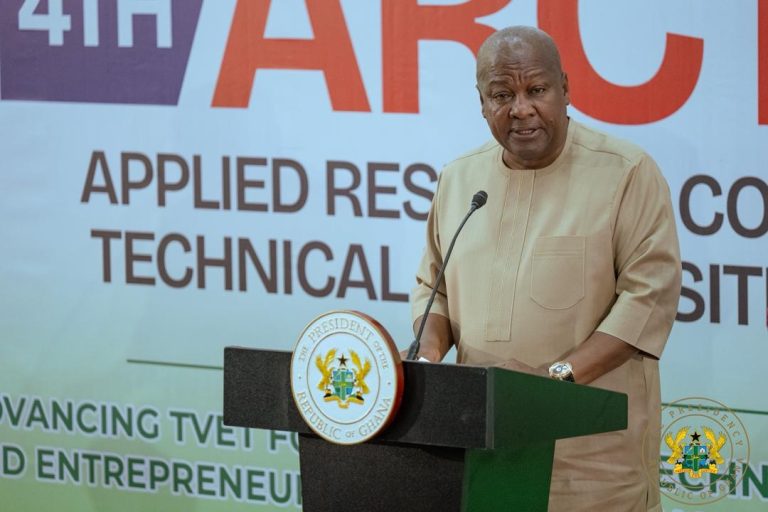

President John Dramani Mahama has announced that the government will reform the water sector and include private sector participation in the supply of industrial water to support manufacturing.
The President made this announcement on Monday at the Presidential Dialogue with the Private Sector in Accra, noting that water supply for manufacturing requires urgent attention.
“The same applies to water, water supply for manufacturing. We must reform the water sector and include private sector participation in the supply of industrial water,” President Mahama stated.
The President explained that across every sub-sector represented at the dialogue, one constraint dominates, which is the cost of energy and reliability of power, but water supply also remains a challenge for industrial operations.
He noted that industrial tariffs in Ghana remain uncompetitive relative to regional peers, and no industrial nation thrives under structurally high costs of power and inadequate water supply.
President Mahama emphasized that the administration will accelerate reforms in both energy and water sectors as foundational requirements for Ghana’s industrial takeoff.
The President stated that energy reform is not optional but foundational to industrial development, and the same principle applies to ensuring reliable water supply for manufacturing facilities.
He explained that the private sector will be engaged to participate in providing industrial water supply, moving beyond sole reliance on public utilities to meet the growing demands of expanding industrial operations.
The water sector reform announcement comes as part of the government’s commitment to address structural constraints facing manufacturers and improve the business environment for industrial growth.
President Mahama noted that the Ghana Chamber of Commerce recently reported that Ghana is losing competitively to Benin, Côte d’Ivoire, and Nigeria, citing several factors including corporate taxation, electricity tariffs, stable power, and duties on machinery and equipment.
He stated that the government will address these competitiveness challenges through structural reform rather than incremental adjustments.
The President announced that the administration will maintain stable macroeconomic policy, provide regulatory clarity, implement industrial financing reform, enforce fair trade, and improve infrastructure including roads, utilities, power, and water.
He emphasized that government commits to regular consultation with the private sector to resolve challenges and obstacles that prevent businesses from growing.
President Mahama called on the private sector to invest and scale up domestic production, create additional Ghanaian jobs, prioritize local content, invest in skills development, maintain international standards for products, and engage transparently in policy dialogue with government.
Richard Aniagyei, ISD