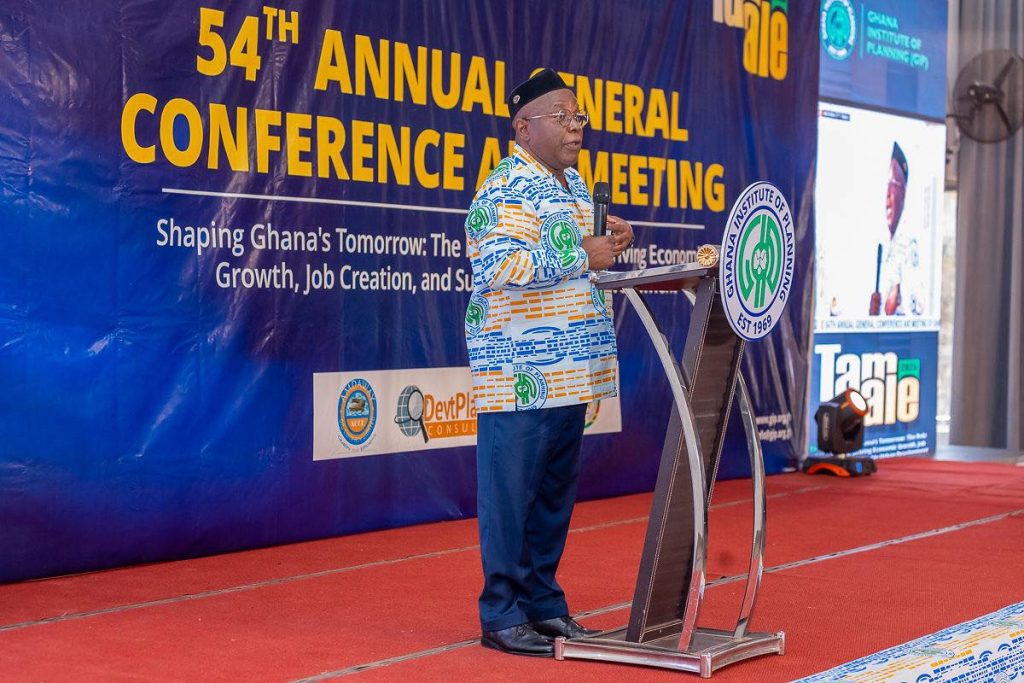
Chairman of the National Development Planning Commission, Dr. Nii Moi Thompson, has called for an integrated long-term National Development Plan, isolated from partisan political cycles, one that ensures prudent consistency, institutional continuity and comprehensive prosperity for generations to come and translate Ghana’s steady economic growth into inclusive job creation and sustainable development.
Speaking at the 54th Annual Conference of the Ghana Institute of Planning (GIP) on Thursday in Tamale, he noted that, “Planning has contributed to macroeconomic stability; however, structural transformation remains limited. Informality, weak skills and inadequate infrastructure continue to constrain growth.”
Dr. Thompson stated that while many planning efforts have achieved significant progress, others have fallen short, hence the lessons from past successes and failures must guide future approaches, especially in aligning long-term visions with short-term strategies and actions.
According to him, rapid urbanization continues to outpace infrastructure provision, with only 13% of District Assemblies having prepared Spatial Development Frameworks which is the essential roadmaps for guiding sustainable infrastructural investment.
He highlighted that Ghana’s informal sector is dominated by small-scale traders, artisans, petty business owners and other micro-enterprise operators, which is about 80 to 90% of the workforce, yet contributes only about 27% of GDP. Adding that, there was the need to re-conceptualize economic growth beyond GDP figures and calls for a renewed focus on structural transformation, equitable employment and sustainable cities.
The Director General of the National Development Planning Commission, Dr. Audrey Smock underscored the important role of planners in enhancing Ghana’s economic trajectory and affirmed that Ghana is well situated to drive systematic transformation, job creation and prolonged urban development.
Dr Amoah stated that, value addition and innovation, better alignment of labour market needs with job creation opportunities, and inclusive urban development is a critical pathway to strengthening economic resilience.
She urged planners to maintain integrity, professionalism and innovation in preparing and executing plans that can turn Ghana’s rapid urbanization into a source of opportunity and expressed confidence that the conference’s outcome would further strengthen planning practice and contribute immensely to the country’s long-term development agenda.
Deborah Narkie Nartey, ISD