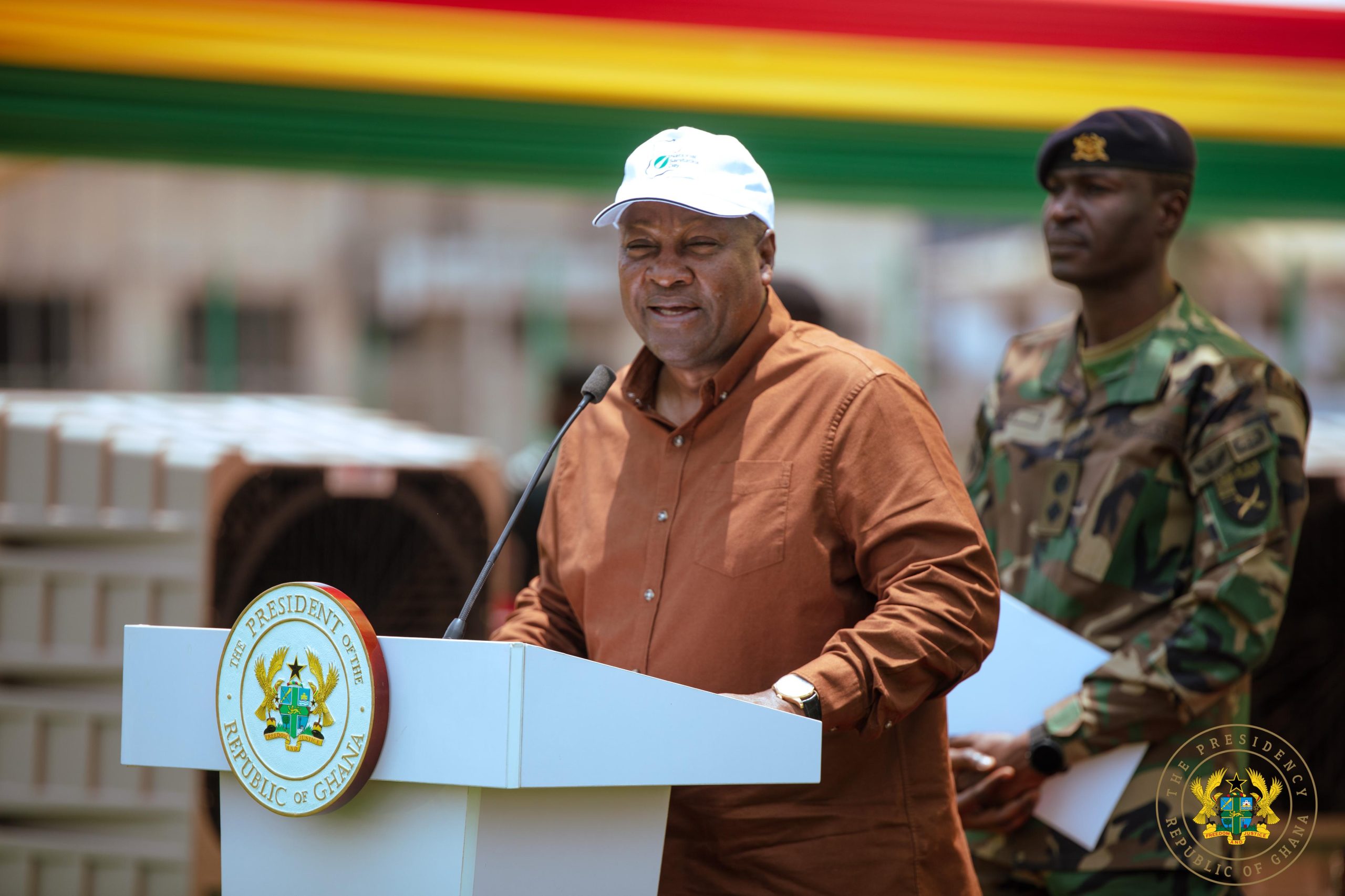
Government has launched the Vegetable Development Project, known as Yɛredua, with solar-powered irrigation facilities in Kukum as government works toward establishing a 24-hour agricultural economy powered by technology and continuous production cycles.
In his remarks at the launching ceremony on Thursday, President John Dramani Mahama, who launched the project said it will be replicated across northern regions where water scarcity presents major challenges during parts of the year.
“We’re laying the foundation for a 24-hour agricultural economy, an economy that is powered by technology, reliable markets and continuous production cycles,” the President stated.
The vegetable initiative forms part of the broader Feed Ghana 2025-2028 Agricultural Transformation Agenda designed to restore the country’s food security and agro-industrial capacity.
Under the program, government is scaling up production of strategic commodities including rice, maize, soya bean, vegetables, cassava, poultry and cashew.
The President outlined several components of the transformation agenda, including establishing farmer service centers to provide mechanization services, input supply, repairs and extension support across the country.
Government will also expand and modernize irrigation infrastructure nationwide, develop commodity-focused cooperatives to strengthen smallholder participation in value chains, and improve storage, marketing and agro-processing capacity to reduce post-harvest losses.
President Mahama said the vegetable sub-sector offers some of the highest returns in agriculture due to its labor-intensive nature, short cropping cycles, and capacity for rapid income generation.
“When we strengthen the vegetable value chain, we’re strengthening household nutrition, we create jobs, we reduce imports and we increase farmers incomes,” the President explained.
Under Yɛredua, the Ministry of Food and Agriculture will introduce climate-smart technologies, improved seed varieties, and sustainable irrigation management techniques.
The program includes structured marketing arrangements with guaranteed off-takes, cold chain and packhouse infrastructure, and capacity building for women-led businesses and youth entrepreneurs.
Government is also establishing linkages to processing industries to promote value addition and connecting farmers to institutional markets including hotels and major supermarket chains.
The President announced targeted initiatives for women and youth, including backyard poultry programs and entry point livelihood support schemes.
Mahama stated that the Upper East region is currently emerging as a hub for innovation, sustainability and commercial-scale production, transitioning from staple foods to high-value horticulture.
“The solar power irrigation facilities we’re establishing here in Kukum will expand dry season production, strengthen farmers cooperatives, supply markets across the country, create employment opportunities for young people, improve household incomes,” he said.
The President commended farmers, Food and Agriculture Minister, development partners, private sector players, and Farm Mate, the company implementing the solar irrigation system.
He reechoed government’s resolve to expanding infrastructure, supporting smallholder and commercial farmers, providing mechanization services, strengthening storage and markets, and investing in agro-processing and value chains.
“With discipline, unity and a shared sense of purpose, we will feed Ghana, we will grow Ghana and we will transform Ghana,” the President declared.
Richard Aniagyei, ISD