
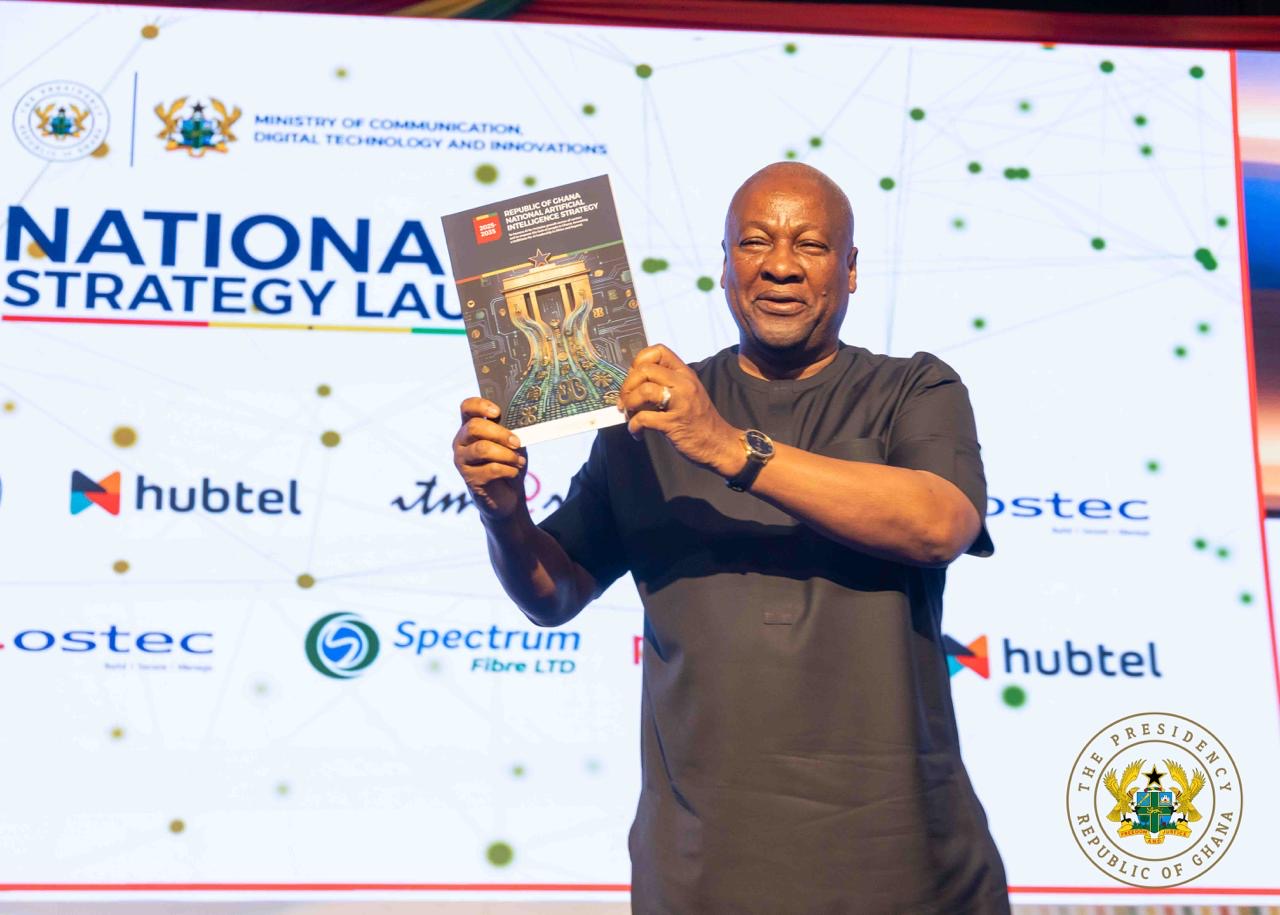
Gov’t has officially launched a National Artificial Intelligence Strategy covering the period 2025 to 2035, sending a clear signal that the country intends to be an active participant in designing, governing and deploying artificial intelligence for national transformation rather than a passive consumer of technologies built elsewhere.
President John Dramani Mahama launched the strategy on Friday, saying, it as a significant milestone in Ghana’s journey towards a digitally empowered, innovation-driven and globally competitive nation.
“This is a statement of intent that Ghana will not be just a passive consumer of technologies shaping the future, but that we are going to be an active participant in designing, governing, and deploying them for our national transformation,” the President said.
He said the global conversation around AI had shifted significantly, moving from fear and suspicion to a recognition that nations which move deliberately and responsibly could harness the technology for enormous good.
Around the world, he noted, AI was already transforming healthcare through faster diagnosis, modernising agriculture through precision farming, reshaping education through personalised learning, strengthening security and improving public service delivery through automation and smarter decision-making.
“From disease surveillance to financial management, from logistics to the administration of justice, AI is no longer a speculative technology of the future. It is already a strategic development tool of our present,” he noted.
The strategy, built on pillars covering ethical and responsible AI development, education and workforce readiness, AI-driven industrial innovation, data governance, research and ecosystem development, and improved public sector performance, will be implemented over ten years with clear targets and indicators across all pillars.
The President emphasised that the strategy was not merely aspirational, pointing to the Ghana Revenue Authority’s current deployment of AI-driven systems to reduce processing time, minimise errors, identify revenue leakages and strengthen domestic revenue mobilisation as evidence that implementation was already underway.
The government also announced plans to establish a Responsible Artificial Intelligence Office to oversee the strategy’s implementation, coordinate stakeholders and drive its objectives through to 2035.
The strategy was developed in collaboration with the Ministry of Communications, Digital Technology and Innovation, the UK High Commission, GIZ, the UN group, the Responsible AI Lab at the Kwame Nkrumah University of Science and Technology and other industry stakeholders.
“Let us build an AI future that is not imported, but is shaped by our own values. Let us deploy innovation not for its own sake, but in the service of our people,” he added.
Richard Aniagyei, ISD