
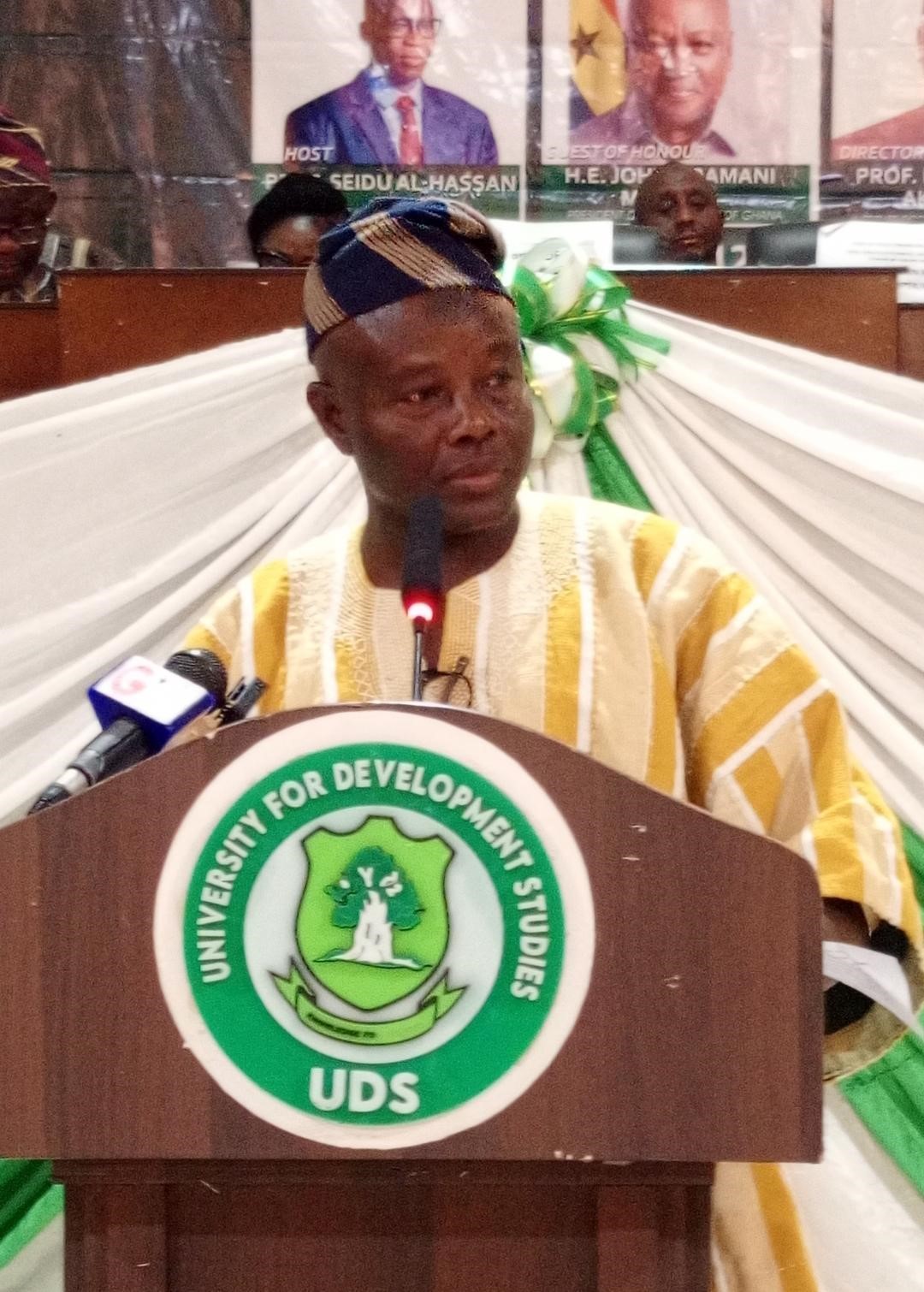
The Chief Director of the Northern Regional Coordinating Council (NRCC), Mr Sumaila Ewuntomah Abudu, has underscored the urgent need to bridge the gap between policy formulation and implementation to accelerate Ghana’s development.
Delivering an address on behalf of the Northern Regional Minister at the opening ceremony of the 20th Harmattan School organised by the University for Development Studies (UDS), Mr Sumaila, praised the university for its consistent commitment to national development through knowledge sharing and policy dialogue.
The event, held on Wednesday, brought together high-profile dignitaries, including Ministers of State, the Presidential Advisor on the 24-Hour Economy, the Vice-Chancellor of UDS, Deans and Directors, development partners, traditional authorities, faculty members, students, and members of the media.
Mr Sumaila described the 20th edition of the Harmattan School as a significant milestone in UDS’s history, noting that for two decades, the programme has served as a vital platform where “ideas meet policy and research meets implementation.”
He commended the university for living up to its motto, “Knowledge for Service,” adding that its dedication to organising the annual Harmattan School demonstrates a firm commitment to ensuring that knowledge directly serves development needs, particularly within local contexts.
“The consistency of UDS in organising the Harmattan School is a demonstration of its commitment to ensuring that knowledge serves development, and that development must be grounded in local realities,” he stated.
Touching on this year’s theme, “From Policy to Practice,” Mr Sumaila described it as both timely and critical. According to him, one of Ghana’s fundamental development challenges lies not in policy design, but in effective execution.
“Ensuring that policies do not merely exist on paper but are effectively translated into meaningful actions that improve the lives of our people is the basis for policy formulation,” he emphasised.
He noted that the Harmattan School provides an essential forum for discussions, learning, and networking aimed at transforming policy aspirations into tangible outcomes that benefit the Ghanaian people.
The Chief Director further observed that Ghana is currently at a defining moment in its development journey, citing flagship national programmes such as the 24-Hour Economy, the Big Push infrastructure agenda, and MahamaCares as transformative initiatives with immense potential.
However, he cautioned that the real test of these programmes lies in their implementation rather than their formulation.
“It is important to note that the real test of these policy programmes is not in their formulation but in the execution,” he stressed.
He therefore called for rigorous discourse and engagement among experts and practitioners to examine these initiatives and provide informed recommendations to enhance their delivery.
Mr Sumaila assured the University of the continued support of the Northern Regional Coordinating Council, acknowledging UDS’s pivotal role in the development of the Northern Region.
“We recognise the role of this University in the development of this region; therefore, we are committed to working closely with the University and other educational institutions to ensure that insights gained from engagements of this nature are leveraged to influence regional-level policies as well as programme and project delivery at the local level,” he affirmed.
He encouraged participants to actively engage in discussions throughout the workshop, noting that their contributions would shape their future roles as leaders, practitioners, and advocates for change.
Mr Sumaila also lauded the inclusion of students in this year’s Harmattan School, describing it as a demonstration of UDS’s commitment to fostering dialogue and empowering future leaders.
He expressed confidence that the initiative would contribute significantly to shaping policies of tomorrow and ultimately the future of Ghana.
The 20th Harmattan School is expected to feature a series of lectures, panel discussions, and interactive sessions focused on strengthening policy implementation frameworks and promoting collaborative governance.
The ceremony concluded with a renewed call for sustained partnerships between academia, government, and development stakeholders to ensure that policies translate into measurable improvements in the lives of citizens.
Issah Fuseini & Salifu Yakubu Abdulai, ISD