
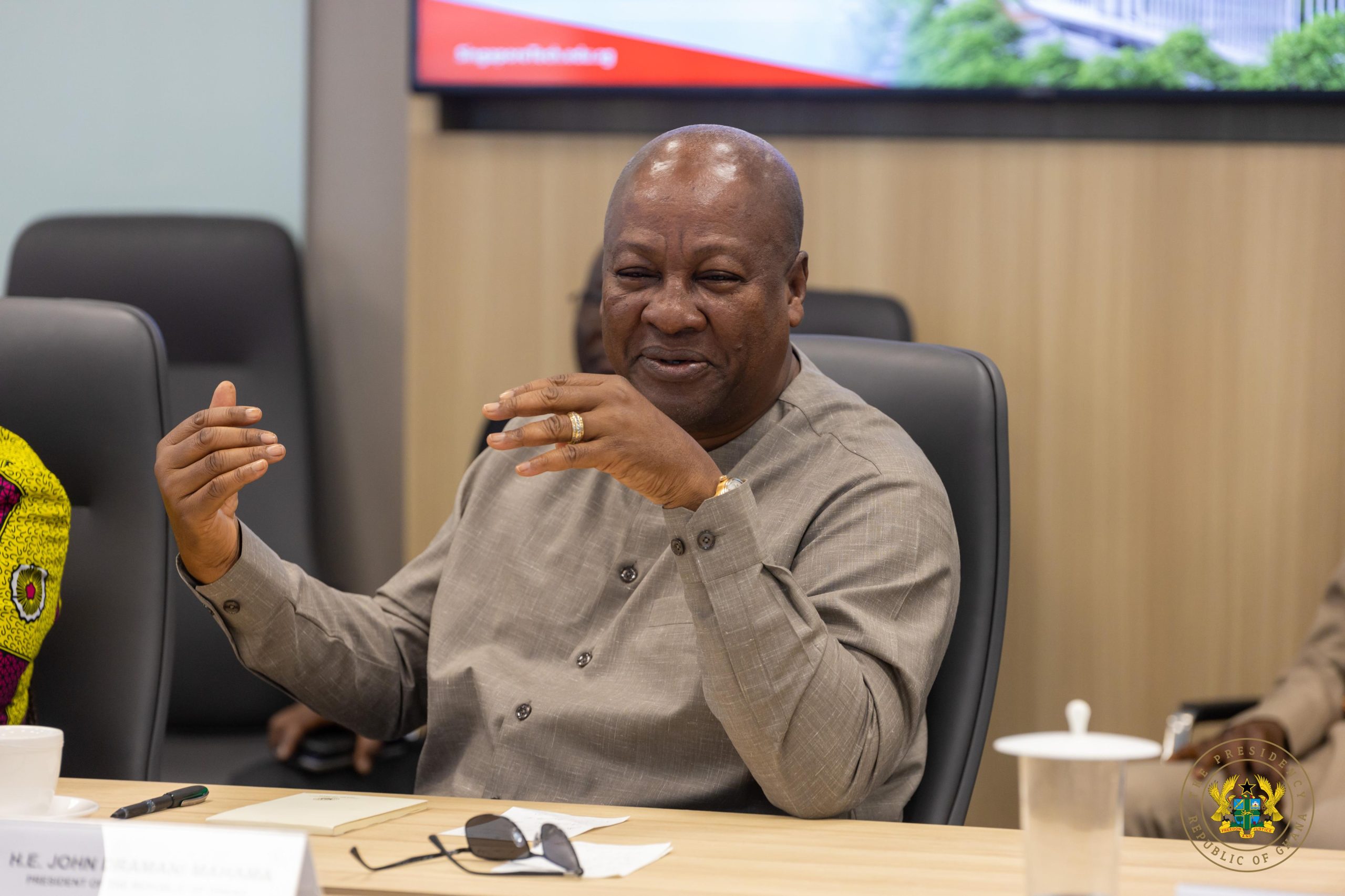
President Mahama Lifts Ban on State Land Transactions with New Safeguards
September 2, 2025 News / Top Stories 0 CommentPresident John Dramani Mahama has announced the immediate lifting of the temporary ban on all state land transactions, introducing strict new accountability measures to prevent the return of past irregularities.
Speaking at the inauguration of the reconstituted National Lands Commission at the Jubilee House, the President declared that all future land transactions must comply with transparent processes, digital verification, and enhanced oversight mechanisms.
“Today, with the inauguration of the new commission and the adoption of robust accountability measures, I’m pleased to announce that the ban on land transactions has been lifted,” President Mahama stated during the ceremony.
The temporary moratorium was imposed by the government to enable a thorough review of existing land administration processes. According to the President, this exercise provided valuable insights into systemic weaknesses and identified urgent reforms required to restore public confidence in land governance.
President Mahama emphasized that lifting the ban does not signal a return to previous practices that characterized Ghana’s troubled land administration system. Instead, he described it as marking the beginning of a new disciplined era of land management.
“The lifting of this ban must not signal a return to business as usual. It is a signal that a new disciplined era of land management has begun,” the President explained.
Under the new framework, all land allocations, leases, and sales must strictly adhere to transparent procedures designed to eliminate the confusion, conflict, and corruption that have plagued Ghana’s land sector for years.
The President noted that public confidence in land governance had reached an all-time low due to multiple sales, endless litigation, extortion, and violence associated with land acquisition.
The President described Ghana’s land administration system as having become “a symbol of everything we seek to change in Ghana,” pointing to problems that persist across rural, peri-urban, and urban areas, with the Greater Accra region being particularly affected.
He cited examples of illegal alienation of forest reserves in the Eastern Region and conversion of public lands in the North as evidence of what he termed “a national tragedy of greed, impunity and dysfunction.”
President Mahama acknowledged that successive years of mismanagement, compounded by political interference and institutional decay, had left the land governance system broken and vulnerable. He noted that independent anti-corruption surveys consistently ranked the Lands Commission among the most distrusted institutions in the country.
The President particularly condemned the role of influential individuals who have used public office as “personal entitlement” to appropriate prime government lands, ecological buffer zones, school reserves, forest enclaves, and other protected areas.
“The unrestrained dissipation of state lands is not the work of the ordinary Ghanaian citizen. It is spearheaded by influential individuals who wield public office, not as a trust, but as a personal entitlement,” he stated.
With the new safeguards in place, the President expressed confidence that the reformed commission would end the era of impunity and usher in a new chapter of integrity in Ghana’s land administration.
Richard Aniagyei, ISD
Post a Comment