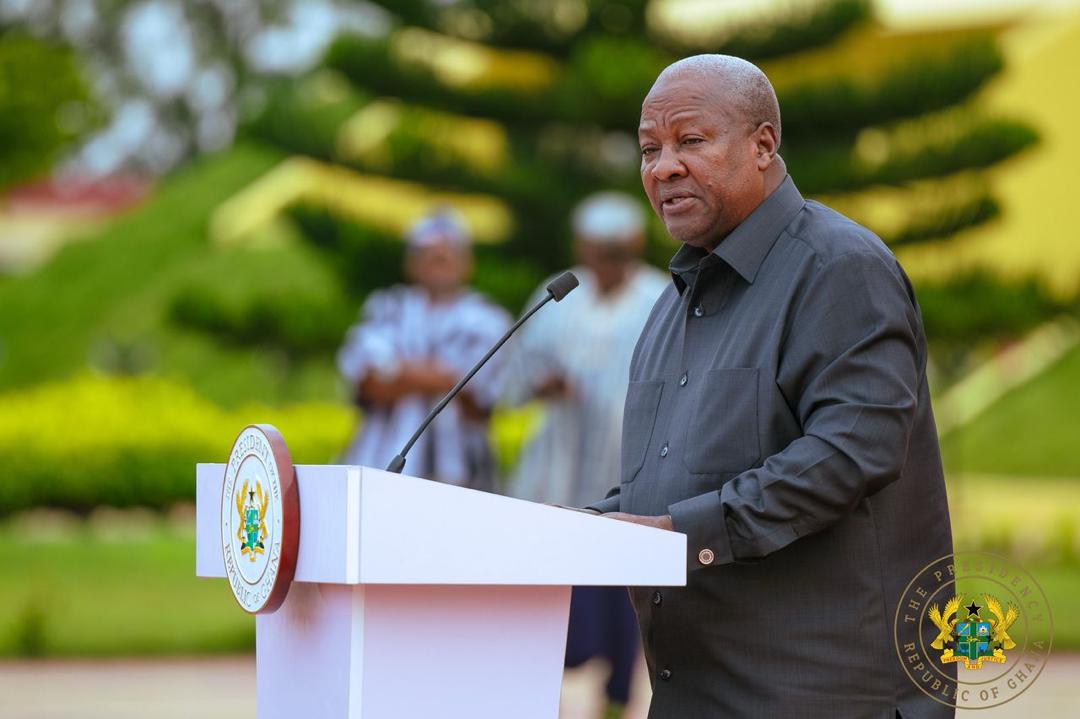
President John Dramani Mahama has challenged other faith-based organisations, corporate institutions and philanthropists to emulate the Church of Pentecost’s model of partnership with the state.
He made this admonition when he commissioned the Damango Prison Camp, built by the Church of Pentecost on Wednesday.
He stated that such partnerships invest in people even when they go astray.
“To the Church of Pentecost, I say once again, your example has illuminated the way for others to follow. I encourage other faith-based organisations, corporate institutions, and philanthropists to imitate this model of partnership. Together, let us build a Ghana where justice is tempered with mercy, discipline with compassion, and power is wielded with purpose,” he said.
The President urged institutions to invest in hope and not despair.
“It challenges us all, governments, religious institutions, civil society organisations, and citizens, to invest in people even when they go astray, to invest in hope and not in despair,” he stated.
President Mahama expressed gratitude to Apostle Eric Nehemiah, the leadership and members of the Church of Pentecost for their faith in humanity and partnership with the state.
“On behalf of the government and people of Ghana, I wish to express our deep gratitude to Apostle Eric Nehemiah, the leadership and members of the Church of Pentecost, for your faith in humanity, your partnership with the state, your belief in Mandela’s dictum, that society’s greatness is measured by how it treats its most vulnerable citizens,” he said.
He noted that the Church of Pentecost has demonstrated that faith involves more than worship but also encompasses practical compassion and transformative action.
“The church has demonstrated once again that faith involves more than worship. It also encompasses practical compassion and transformative action. From Ejira to Nsawam, the church has constructed not just monuments, but sanctuaries of hope, places where lives are rebuilt and futures are restored,” he stated.
The President recalled that in 2021, the church financed and handed over the Ejura camp prison in the Ashanti region, followed by the Nsawam camp prison in the Eastern region. He added that the Obuasi camp prison, which is currently under construction, will soon join this tradition of faith-driven development.
President Mahama announced that the government is implementing far-reaching prison reforms.
“Our administration’s prison reform agenda rests on a fundamental belief that no Ghanaian should be stripped of their humanity even when they are in prison. We are therefore implementing far-reaching reforms,” he said.
He stated that the reforms include expanding the use of alternative sentencing for minor and non-violent offenses.
“Expanding the use of alternative sentencing for minor and non-violent offenses, reviewing bail conditions to avoid undue hardship, especially for the poor, introducing a parole system to reward good behavior and accelerate reintegration,” he said.
The President added that government is completing the 800-inmate capacity remand prison at Nsawam, initiated by his previous administration in 2016, which has been left abandoned.
He noted that government is also developing modern correctional centres for men, women and juveniles.
“We’re enhancing the conditions of service for our prison officers, modernising prison infrastructure, and expanding rehabilitation programs connected to sustainable livelihood and employment after release,” he stated.
President Mahama said the Damango facility embodies a restorative and not punitive philosophy of incarceration.
“This facility is more than just a place of confinement. It is a sanctuary for rehabilitation, a centre for second chances, and a workshop for transforming lives. Equipped with modern living quarters, classrooms, workshops, healthcare units, and a digital learning facility, the Damango camp prison embodies a new philosophy of incarceration,” he said.
He explained that the philosophy is not punitive but restorative and not dehumanising but dignifying.
“One that is not punitive, but rather restorative. One that is not dehumanising, but rather dignifying. It embodies our belief that justice must always go hand in hand with mercy, and that the ultimate aim of punishment should be to reform and reintegrate, and not to reject,” he stated.
The President noted that the reform efforts align with the United Nations Standard Minimum Rules for the Treatment of Prisoners, also known as the Nelson Mandela Rules.
“Ghana continues to be in active partnership with the United Nations Office on Drugs and Crime, the African Union, the ECOWAS, and other international organisations working to promote humane conditions in prisons. We will therefore continue to share experiences and adopt best practices and participate in global efforts to make our justice system fairer, more humane, and more effective,” he said.
Richard Aniagyei, ISD