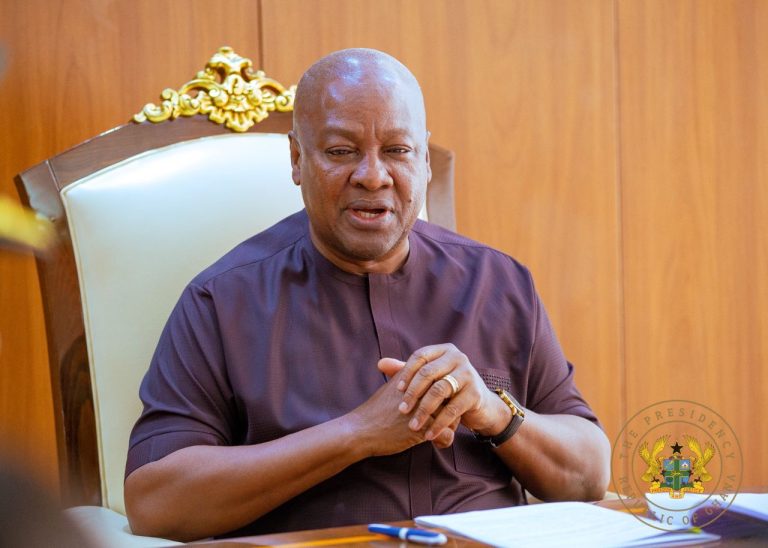

President John Dramani Mahama has called for state-owned media houses to adopt digital subscription models and improve programming to remain relevant as Ghana’s media landscape undergoes technological transformation.
Speaking during a courtesy call by Ghana Journalists Association (GJA) executives at the Presidency, President Mahama said traditional media consumption patterns have changed, with fewer people reading newspapers or watching conventional television as audiences migrate to digital platforms.
“People are reading fewer newspapers. People are watching less of the traditional media and getting a lot of their information from short videos and bloggers and other things,” President Mahama stated.
The President cited international examples such as the New York Times and Financial Times, which he said have successfully transitioned to digital subscription models despite declining hard copy sales.
He described how these publications use compelling content teasers to attract online subscribers.
“They tease you with a very interesting story. And then when you open, you read a bit of it, then it stops. And then it says, subscribe,” President Mahama explained, suggesting Ghanaian media could adopt similar strategies.
President Mahama praised Graphic Communications for its online system and urged other state media organizations like Ghanaian Times to follow suit in embracing digital transformation.
He emphasized the need to take media operations into the digital age while maintaining their public service mandate.
The President called for improved programming that incorporates more visual elements and illustrations to make content more engaging for modern audiences who expect dynamic presentation styles.
He said traditional formats featuring lengthy discussions without visual support tend to lose viewer attention.
“People now want more illustration. And so just having people sitting there for one hour and talking and discussing something can get boring. They will tune off,” President Mahama observed.
However, President Mahama defended the continued role of state-owned media despite calls for privatization, arguing that public broadcasting serves non-commercial purposes that private media cannot fulfill, particularly in local language education and programming for specific community segments.
According to President Mahama, adult education programming in local languages exemplifies content that only state media like GBC would produce, as private stations avoid such non-commercial programming.
“Who will do the local language education if GBC were not there? I mean, nobody who has a private station wants to do adult education in Dagbani and things like that. It’s GBC that will do it,” President Mahama argued.
The modernization discussion emerged as President Mahama addressed broader changes in Ghana’s media landscape driven by technology and digital platforms.
He explained that bloggers and citizen journalists now compete with traditional media, fundamentally changing how news is produced and consumed.
“The media landscape has changed and the sources of information has changed. And in many cases, it is those people who are setting the agenda,” President Mahama stated, referring to bloggers who attend events alongside trained journalists using smartphones to capture, edit and publish content.
The President noted that traditional media houses frequently rely on content produced by these unregulated digital content creators, with morning radio programs often drawing material from blogger coverage of events.
“For most of our stations in the morning, they’re taking a lot of news from what 1957 covered or what GH something something covered. And they have all these little inscriptions they put on their videos. And that drives the discussion in the morning,” he observed.
President Mahama raised concerns about regulatory challenges posed by the new media landscape, particularly regarding extreme content produced by some bloggers, including what he described as filthy language, personal insults, and material bordering on hate speech.
“The language is filthy. I mean, they can just go to town either insulting somebody or sometimes on the limits of hate speech. And these are things that, in the whole world, people are beginning to look at and say, how can we regulate hate speech?” President Mahama stated.
The President posed fundamental questions about how society should classify these new content creators, asking whether bloggers should be considered journalists in the traditional sense and what regulatory frameworks might apply to their work.
President Mahama emphasized that successful media modernization requires balancing technological adaptation with maintaining the unique public service role that distinguishes state media from purely commercial operations.
Richard Aniagyei, ISD