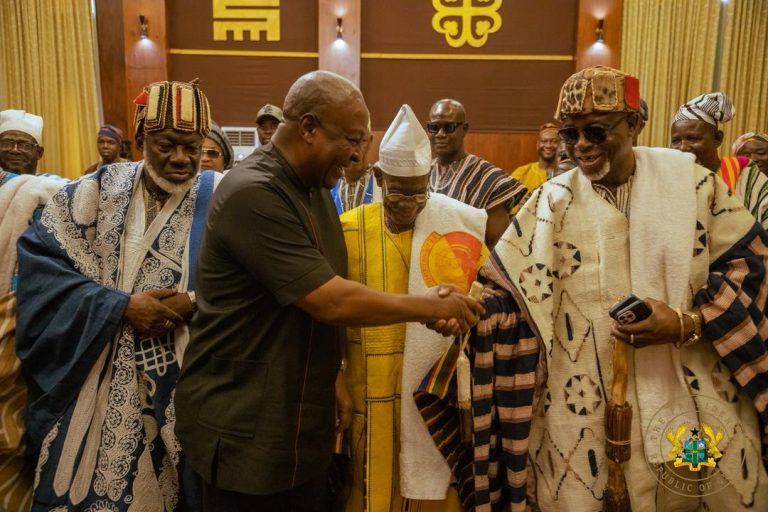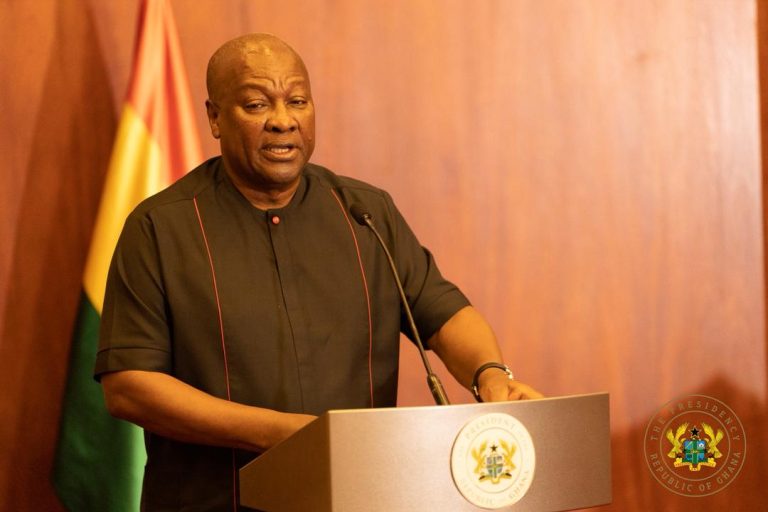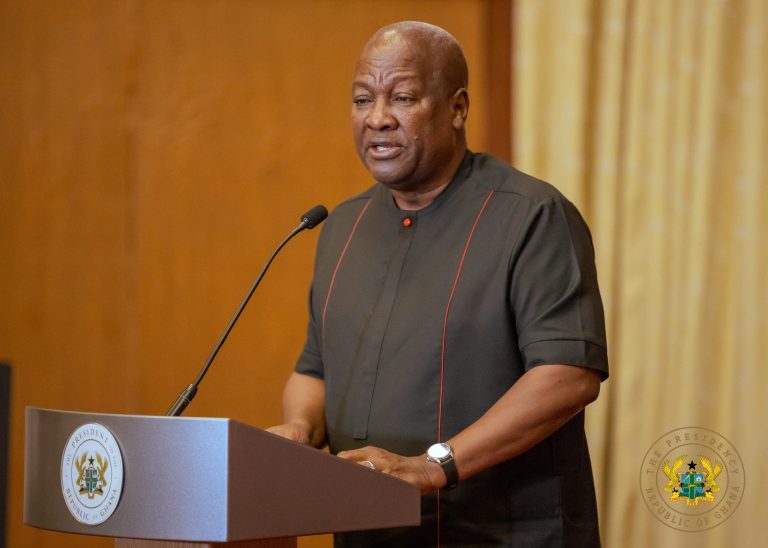

President John Dramani Mahama has inaugurated the newly reconstituted National Lands Commission with a clear charge to eliminate corruption, end impunity, and transform Ghana’s troubled land governance system.
Speaking at the Jubilee House ceremony on Tuesday , the President described the commission’s assignment as generational, tasking members with resetting Ghana’s land governance for the 21st century.
“Your assignment is generational. You have been entrusted with the sacred task of resetting Ghana’s land governance for the 21st Century,” President Mahama told the new commissioners.
The President granted the commission full backing from the presidency to act boldly and impartially in eliminating bottlenecks and rent-seeking while upholding the Constitution and always acting in the national interest.
President Mahama delivered a stern warning that corruption within the Lands Commission would no longer be tolerated or treated with indifference.
He expects the new leadership to institute strict internal accountability measures without shielding corrupt staff or compromising their integrity.
“Corruption within the Lands Commission will no longer be tolerated or treated indifferently. I expect the new Commission’s leadership to institute strict internal accountability measures,” the President declared.
The President specifically condemned practices that have plagued the commission, including absenteeism, manipulation of processes, and deliberate delays designed to exact bribes from citizens.
He called for the new commission to embody work ethic, transparency, and discipline.
“Let this new commission be one of work ethic, transparency and discipline, the days of absenteeism and lands commissions manipulation and deliberate delays to exact bribes must come to an end,” President Mahama stated.
The commission has been tasked with ensuring that no land document takes more than 30 working days to process and that no Ghanaian should have to pay bribes or rely on personal connections to register their land.
Revenue accountability forms another major responsibility for the new commission. The President demanded that all income generated from ground rents, premiums, and other services be properly accounted for and used to enhance service delivery rather than personal enrichment.
The President outlined specific operational changes expected from the commission, including working closely with the Land Use and Spatial Planning Authority and Metropolitan, Municipal, and District Assemblies to enforce zoning and planning regulations, protecting public lands reserved for schools, clinics, markets, and green spaces, and integrating land use planning with national development priorities.
President Mahama emphasized that urban development must be guided rather than improvised, reflecting his administration’s commitment to orderly growth and proper planning.
The new commission faces the challenge of addressing what the President described as a system that had become “a symbol of everything we seek to change in Ghana.”
He noted that successive years of mismanagement, political interference, and institutional decay had left the land governance system broken and vulnerable.
The President reminded commissioners that independent anti-corruption surveys consistently ranked the Lands Commission among the most distrusted institutions in the country, making their reform mission even more urgent.
He charged the commission with implementing a four-pillar reform agenda: restoring public confidence through transparency and justice, reversing illegal transactions and reclaiming encroached lands, digitizing and modernizing land services, and harmonizing customary and statutory land systems.
President Mahama concluded his charge with a philosophical reminder about land stewardship, telling commissioners: “We do not inherit land from our ancestors, we borrow it from our children.”
He called on the commission to act boldly, wisely, and selflessly to protect land resources, reform systems, and restore public trust, expressing his expectation that this commission would be remembered as one that transformed Ghana’s land sector not only in policy but in practice.
Richard Aniagyei, ISD