President John Dramani Mahama has announced a target of $2 billion in annual export earnings from each of Ghana’s six priority tree crops by 2035, bringing total export revenues from the sector to $12 billion.
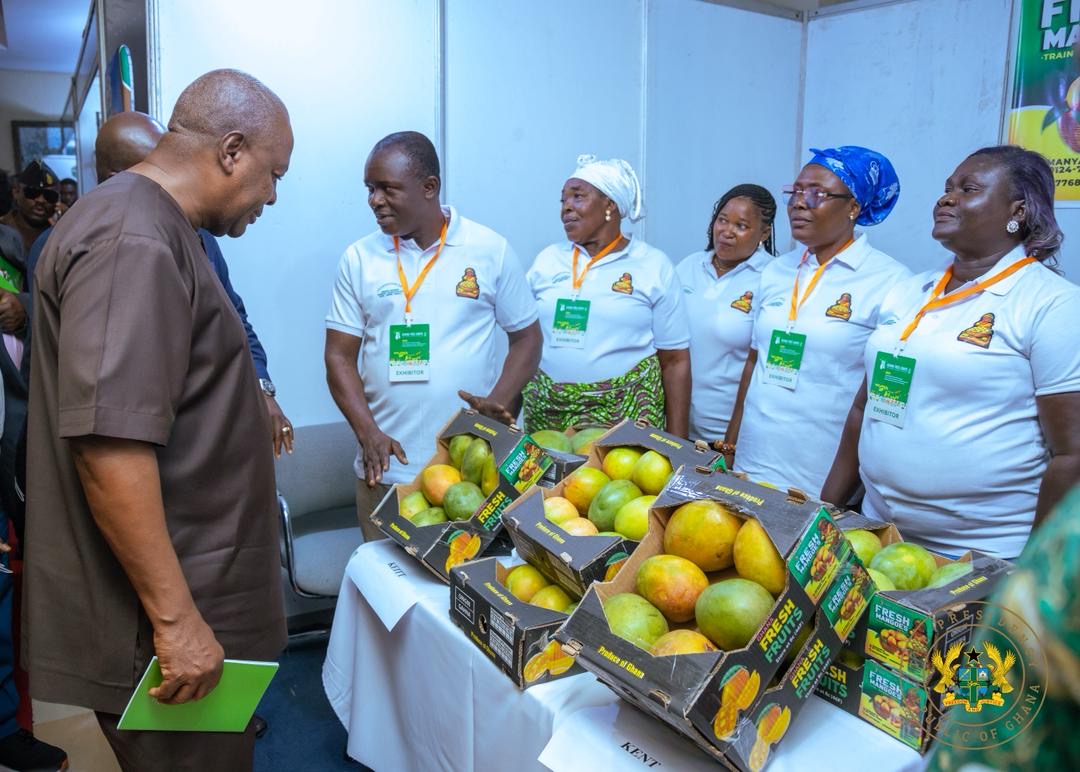
The President made the announcement on Tuesday at the inaugural Ghana Tree Crops Investment Summit and Exhibition 2026 in Accra, where he officially relaunched the Ghana Tree Crop Diversification Project.
The six priority crops are cashew, coconut, oil palm, rubber, mango, and shea, which together currently employ over 1.6 million Ghanaians and contribute 2% to Ghana’s GDP and 4.5% to agricultural GDP.
“Our 2035 ambition remains $12 billion annual exports, which will translate to $2 billion per crop. So for all the crops mentioned, from coconut to cashew to rubber, we expect $2 billion in export earnings from each of these sectors,” President Mahama stated.
To achieve this goal, President Mahama announced that Ghana will no longer export raw cashew, shea, or unprocessed rubber while importing the same finished products at higher prices.
The government has set a clear target of 50% to 60% local processing annually, supported by expansion of agro-industrial parks, incentives for private sector processors, and stronger regulatory oversight through the Tree Crops Development Authority.
“We will no longer export raw cashew. And so I invite our investment partners who export cashew to come and build the capacity to process our cashew locally. I want to travel and be able to buy cashew and see produce of Ghana, not produce of India, or produce of some third-party country,” the President declared.
Under the relaunched $200 million World Bank-supported Ghana Tree Crop Diversification Project, 7.8 million cashew seedlings, 2.3 million rubber seedlings, and 3.9 million coconut seedlings will be distributed to over 30,000 farmers.
The programme will benefit 52,775 households directly, with 185 small and medium enterprises receiving matching grants to support processing and value addition.
For oil palm development, the government has committed $500 million under the National Policy on Integrated Oil Palm Development, dubbed “Red Gold,” to develop 100,000 hectares and create 250,000 direct jobs.
President Mahama said achieving this target will eliminate the 40% oil palm imports Ghana currently brings in from other countries and make Ghana a net exporter of oil palm.
The President explained that the administration is committed to expanding Ghana’s export base and leveraging the African Continental Free Trade Area to position Ghana to supply West African, Middle Eastern, and Asian markets while reducing foreign exchange vulnerabilities.
He noted that the tree crop sector aligns with the government’s 24-hour economy framework, where production, processing, logistics, and exports operate continuously around the clock to maximize productivity and create jobs.
President Mahama emphasized that women and youth will be central to the tree crop transformation, noting that shea supports over 500,000 households, mostly women, while cashew employs nearly 890,000 people, rubber supports about 500,000 farmers, and oil palm provides jobs for over 120,000 Ghanaians.
“Agriculture must be modern, it must be profitable, and it must be attractive to young people,” the President stated.
He directed the Tree Crops Development Authority and the Ghana Cocoa Board to expedite implementation of the programme, stressing that farmers must see results, not paperwork.
President Mahama described the summit as a turning point at which Ghana decisively shifts from raw exports to industrial processing, from vulnerability to resilience, and from promise to performance.
Richard Aniagyei, ISD