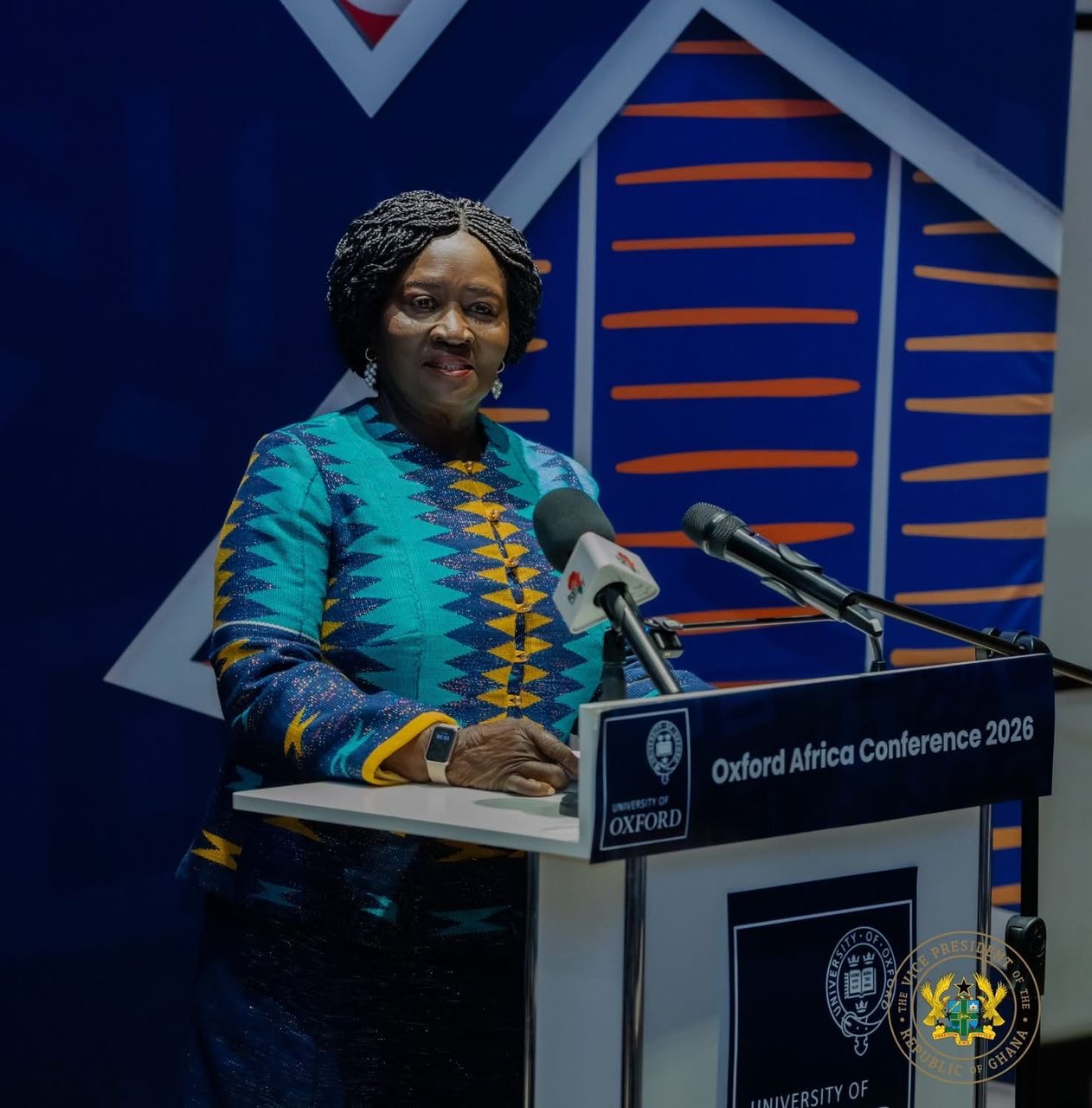
The race for dominance in artificial intelligence, digital infrastructure, and data sovereignty is already underway, and Africa cannot afford to watch from the sidelines, Vice President Professor Naana Jane Opoku-Agyemang has warned.
Speaking at the 16th Oxford Africa Conference in the United Kingdom, Opoku-Agyemang said the continent faced a clear choice: develop technologies and solutions rooted in its own realities, or remain permanently dependent on systems designed elsewhere for purposes that may not reflect African needs or priorities.
“Africa cannot remain solely a consumer of externally built systems,” she said, calling on the continent to actively position itself to lead in artificial intelligence, digital infrastructure, energy transition, and data sovereignty.
The conference, organised annually by the Oxford Africa Society, brought together leaders, academics, students, and innovators to discuss Africa’s future under the theme “Anchoring Africa: Grounded Leadership in the Age of Disruption.”
Prof Opoku-Agyemang said the technology question could not be separated from the broader question of governance and leadership.
Transformation, she argued, required leaders who were not only visionary but disciplined, ethical, and deeply connected to the communities they served. Policy without delivery, she said, was not leadership.
She pointed to the African Continental Free Trade Area as one of the most consequential openings available to the continent, saying it presented real opportunities for market integration and economic growth if African countries organised themselves deliberately around it.
On Ghana’s own reform efforts, she cited the shift toward local cocoa processing and the 24-Hour Economy policy as examples of a broader move away from raw material dependency toward value addition and sustainable economic development.
The Vice President also made the case for bringing women fully into Africa’s economic transformation, spotlighting the proposed Women’s Development Bank as a practical intervention.
She noted that women formed the backbone of informal trade across the continent yet remained largely shut out of formal financial structures.
The bank, she said, was designed to go beyond credit access and equip women with the skills to grow and compete within a changing economy.
Africa’s future, she concluded, would be shaped not by the disruptions confronting it but by how deliberately and collectively the continent chose to respond to them.
Richard Aniagyei, ISD