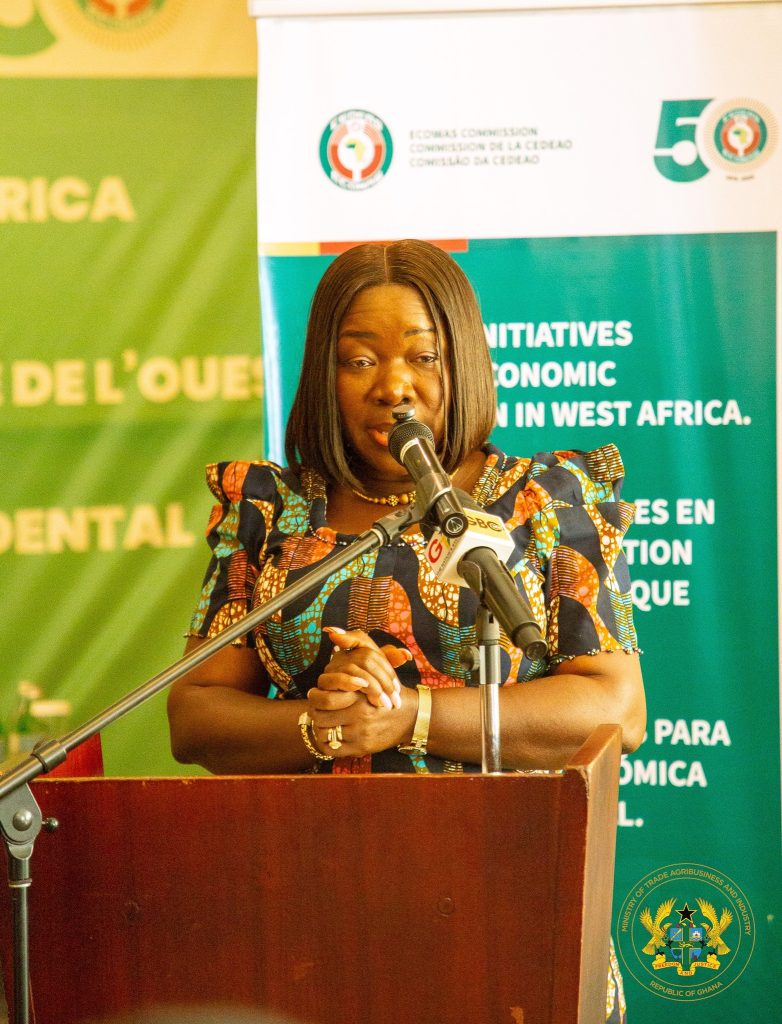
The Minister for Trade, Agribusiness, and Industry, Mrs. Elizabeth Ofosu-Adjare, has called on ECOWAS Member States to demonstrate renewed commitment to deepening regional integration and dismantling barriers that limit trade, investment, and the free movement of goods and people across West Africa.
This was at the opening of the ECOWAS three-day regional programme on “Regional Intervention Towards Economic Integration in West Africa” on Wednesday in Accra.
She called for a “deliberate, tangible action” to strengthen regional value chains, harmonize standards, and expand market access under the African Continental Free Trade Area (AfCFTA).
The Minister highlighted persistent challenges, including non-tariff barriers, inconsistent standards, high freight costs, and poor corridor infrastructure that continue to keep intra-ECOWAS trade low, averaging just 6% between 2022 and 2024.
Mrs Ofosu-Adjare also outlined Ghana’s progress under the AfCFTA Guided Trade Initiative, citing the establishment of a Ghana Trade House in Nairobi, market expeditions to East Africa, and the issuance of 581 certificates of origin by February 2025.
She reaffirmed Ghana’s commitment to strengthening SMEs, updating national AfCFTA action plans, and investing in priority value chains such as textiles, cashew, cocoa, and fisheries to boost employment and drive economic transformation.
The Head of the Department of Economic Affairs and Agriculture of the ECOWAS Commission, Dr. Kalilou Sylla, reiterated the Commission’s commitment to trade facilitation, standards harmonization, and improving agricultural market information systems across the block.
He stressed the importance of solidarity in the face of regional security challenges and highlighted Ghana’s historical and strategic role in West Africa’s integration journey.
Dr. Sylla further encouraged Member States to collaborate in overcoming global trade restrictions by boosting intra-regional commerce and ensuring the free movement of goods.
Judith Twumwaa, ISD