President John Dramani Mahama has called on the African Union (AU) to lend full and unflinching support to Ghana’s historic resolution seeking global recognition of the transatlantic slave trade as one of the gravest crimes against humanity.
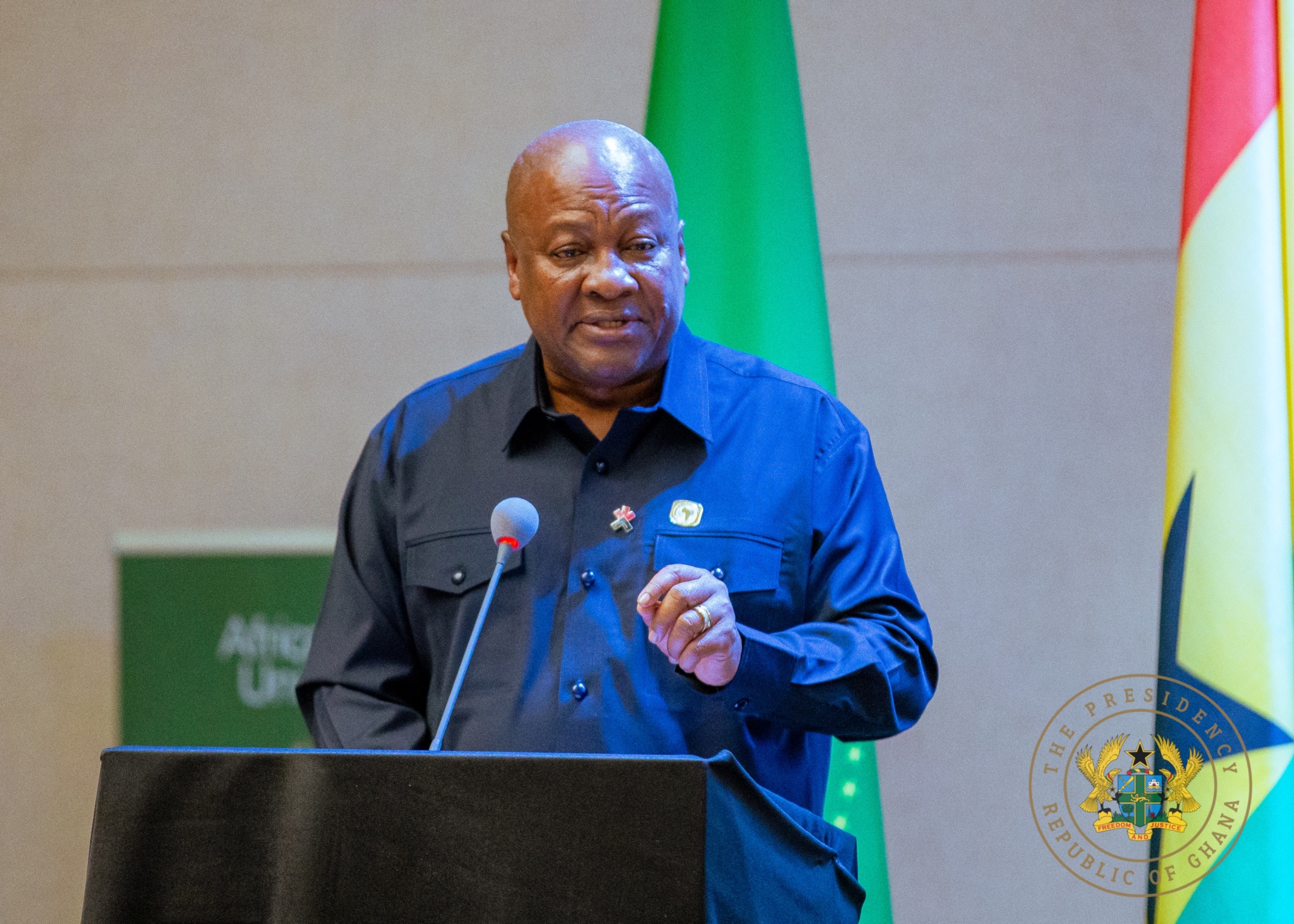
The President made the appeal during a high-level panel on reparations at the 39th Assembly of Heads of State and Government of the African Union in Addis Ababa, Ethiopia, on Friday.
President Mahama disclosed that Ghana has initiated the process to table the resolution at the United Nations General Assembly in March this year, reiterating an announcement he made during the 80th session of the UN General Assembly last September.
“I urge the forthcoming 39th Assembly of the AU to lend full and unflinching support to this historic resolution,” President Mahama stated.
He revealed that a zero draft of the proposed resolution will soon be circulated to all member states for consultation and coordinated advocacy, emphasizing the need for Africa to speak with one voice on the matter.
The President stressed that the resolution is not symbolic diplomacy but a necessary moral clarification of history, noting that the evidence is compelling, the legal foundations are firm, and the moral imperative is undeniable.
Speaking as AU Champion on Reparations, President Mahama said the initiative aligns with the broader framework of the African Union’s 2025 Year of Justice for Africans and People of African Descent through Reparations, which also marks the commencement of the Decade of Reparations declared by the AU.
“This is not ceremonial language. It is a call for structural reform,” he stated.
The President outlined that reparative justice must be holistic and encompass four interconnected pillars: cultural restitution, economic redress, political empowerment, and psychological healing.
He asserted that restitution is not about art and sculpture alone but about justice, sovereignty, and restoring memory without distortion while reclaiming Africa’s rightful voice in the history of the world.
President Mahama told the gathering that for too long, the story of Africa was told through foreign lenses, with sacred objects, royal regalia, ancestral artifacts, and ceremonial relics violently severed from the spiritual, intellectual, and civilizational ecosystems that gave them meaning.
“These artifacts were displayed behind glass showcases in distant capitals. They became aesthetic curiosity stripped of context, detached from community and divorced from their original identity,” he said.
The President called upon all member states, regional economic communities, local authorities, cultural institutions, and international partners to move from moral aspiration to binding frameworks with clear timelines and measurable outcomes.
“We must speak with one voice until every African object that’s unjustly held abroad is returned, not merely to a location but to a people, returned to a living culture, returned to its rightful spiritual and historical origin,” President Mahama declared.
He emphasized that Africa’s demographic dynamism and youth must stand at the heart of the reparations movement, stating that young people should not experience their heritage as something located behind foreign glass showcases.
“They must encounter our heritage in their communities, in their classrooms, in our museums, in our festivals and in our digital spaces,” the President said.
President Mahama called for technology to bridge time and geography and for diaspora exchanges to deepen solidarity through educational initiatives connecting Kinshasa with Kingston, Jamaica, Accra with Bahia, and Addis Ababa with Cartagena.
He referenced the 2023 Common African Position on the Restitution of Heritage Resources, which he said is not merely a policy instrument but an ethical compass asserting that restitution is grounded in international law and human rights.
The President noted that the enduring architecture of colonial inequity must give way to a more just global order, and that restitution mechanisms must be restorative, not extractive.
“We cannot speak of development without identity. We cannot speak of unity without acknowledging historical erasure,” President Mahama stated, quoting Pan-Africanist Marcus Garvey who said a people without the knowledge of their history, origin, and culture is like a tree without roots.
He warned that hesitation at this decisive intersection between memory and justice risks leaving future generations a continent dispossessed, not merely of objects but of meaning.
“Let us not defer justice. Let us not postpone dignity. Let us act, and let us act together,” the President concluded.
President Mahama acknowledged UNESCO’s partnership in advancing the reparations agenda, noting that cultural heritage is not static but connects past identity with future possibilities.
He declared that Addis Ababa 2026 should mark a turning point where Africa chose to honor its past and define its future, transforming memory into policy, converting grievances into collective strategy, and turning history into sovereign action.
The high-level panel took place under the theme “Reparations, Memory and Sovereignty” as part of the AU’s broader commitment to justice for Africans and people of African descent.
Richard Aniagyei, ISD