President John Dramani Mahama has expressed Ghana’s readiness to undergo a thorough peer review.
He described the mechanism as an important exercise that will afford the country the opportunity to assess progress made and identify interventions to improve governance.
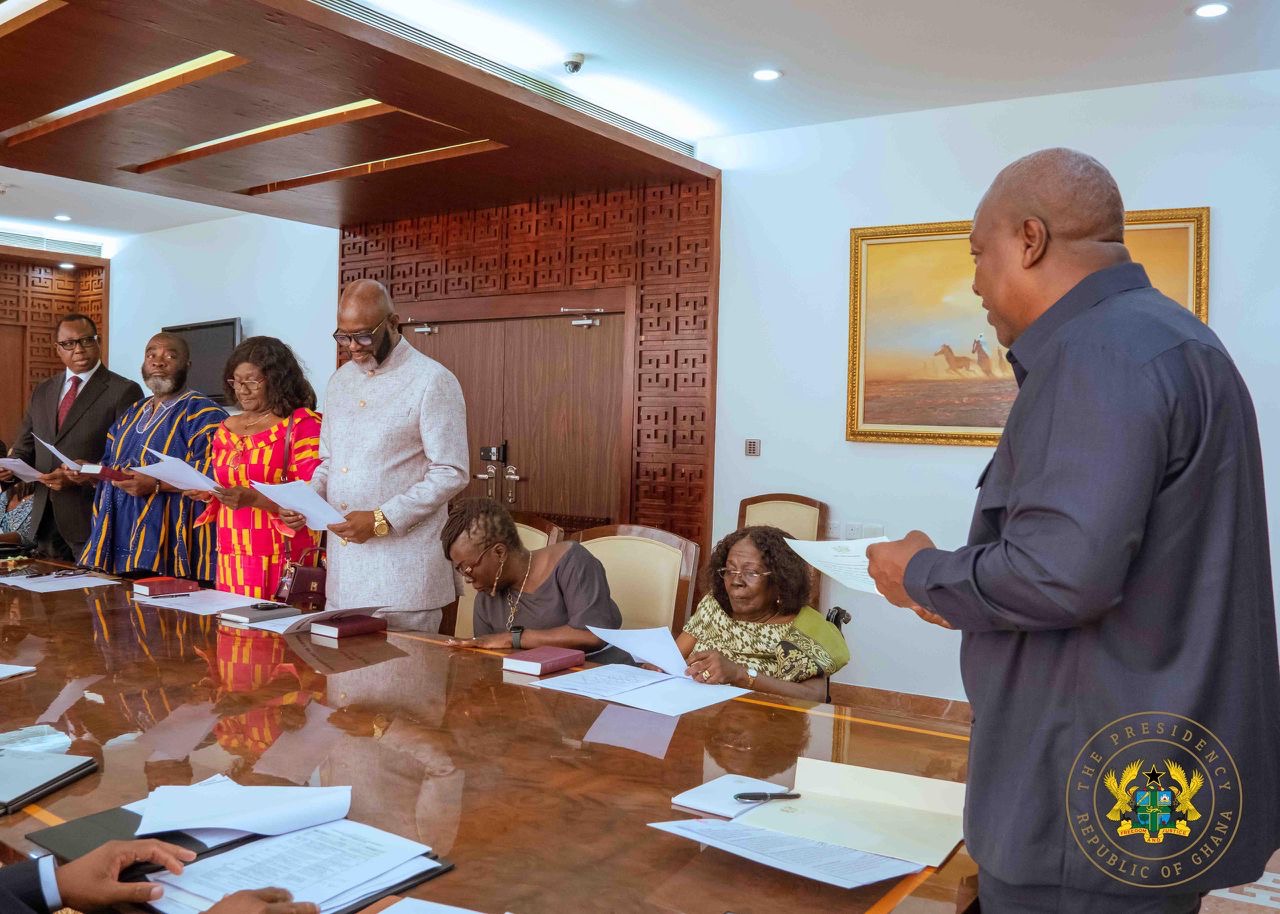
The President made these remarks after swearing-in members of the National African Peer Review Mechanism Governing Council (NAPRM-GC) at the Presidency in Accra.
According to him, the new Council is expected to lead the second generation review of Ghana next week on the sidelines of the African Union Summit scheduled to take place in Addis Ababa, Ethiopia.
“We’re willing to do that and we’ll be available to lead that process,” he assured.
President Mahama noted that Ghana was among the first countries to accede to, volunteer, and undergo a complete peer review process back in 2006.
“It’s been an issue of pride for us that Ghana’s democracy, accountable governance, and everything that we are noted for, will be subjected to review by our peers,” he stated.
He observed that one outcome from the previous review was the identification of the large gap between the deprived Northern belt of Ghana and the South, which eventually led to the establishment of the Savannah Accelerated Development Authority (SADA) as a platform to provide direct development assistance and stem migration from North to South.
“So we want to know what has happened to those inequalities and what the level of opportunities we have opened up in other parts of the country are,” the President said.
The Chairman of the new Governing Professor Akua Kuenyehia, in a brief remark, Professor Kuenyehia expressed gratitude to the President and assured him of their commitment to uphold transparency and the independence of governance institutions.
Other members are Dr. Joseph Whittal, Chairman of the National Commission for Human Rights and Administrative Justice (CHRAJ), Mr. Joseph Obeng, Mr. David Ofosu-Dorte, and Mrs. Cornelia Amoah.
The African Peer Review Mechanism is a voluntary, mutually agreed self-monitoring instrument established in 2003 by the African Union to promote good governance, political stability, and sustainable development.
It facilitates national dialogue and self-assessments of policies across four areas: democracy, economic management, corporate governance, and socio-economic development.
Richard Aniagyei, ISD