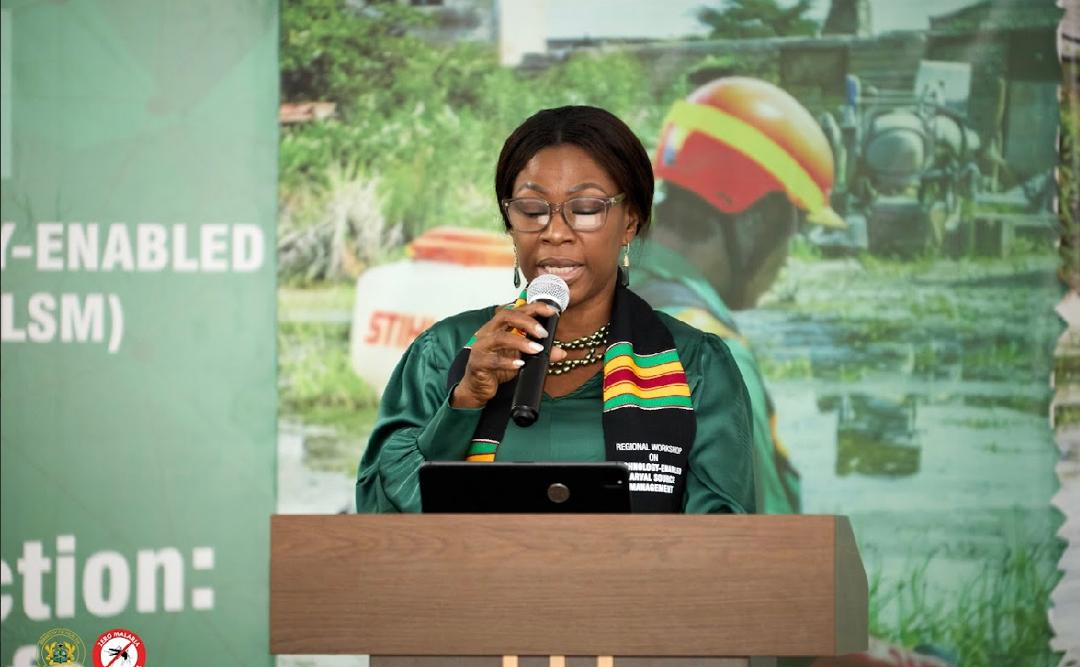
The Deputy Minister of Health (MOH), Prof. Dr Grace Ayensu-Danquah, has reaffirmed the ministry’s commitment to support the National Malaria Elimination Programme, moving Ghana and the continent closer to a malaria-free future.
The Deputy Minister said this at a two-day summit of the Ghana Health Service held in Accra with the theme “Prevention at the Source.” The workshop sought to advance bold, technology-driven strategies aimed at eliminating malaria through smarter, data-informed interventions.
She remarked, “If we are to end malaria, we must outpace it. Technology now gives us the power to predict, detect, and respond with precision. Prevention at the source is not just a strategy — it is our responsibility.”
She commended the collaborative partnership between government institutions and technology innovators, emphasising that malaria elimination requires cross-border cooperation, shared learning, and unified political will.
“This gathering demonstrated that Africa is not waiting for solutions — we are building them,” she added.
The Director-General of the Ghana Health Service, Dr Samuel Kaba Akoriyea, said Ghana had made significant progress, recording 74 malaria deaths in 2024, down from 146 the previous year. Innovative interventions must be sustained and improved.
“Our National Malaria Elimination Strategic Plan for 2024-2028 is ambitious, and to achieve it, we must embrace every effective tool available, including tech-led larval source management,” he said.
Dr Fiona Braka, the World Health Organisation (WHO) country representative, noted that vector-borne diseases continue to contribute significantly to the global burden of communicable diseases, with climate change, environmental variability and population movement driving their spread.
She emphasised that vector control accounted for a substantial proportion of the reduction in global malaria burden since 2000 and called for data-driven, evidence-based LSM.
This includes using affordable and innovative tools such as AI, drones and remote sensing in achieving the elimination status.
The workshop showcased a revolutionary toolkit designed to transform larval source management across Africa, including: Drone Mapping and AI Detection – Harnessing aerial surveillance and artificial intelligence to identify mosquito breeding sites with unprecedented accuracy, Digital Micro-planning – Enhancing efficiency by allocating resources based on real-time, data-driven insights and Real-Time Monitoring Systems – Equipping field teams with instant data tools to enable rapid, targeted interventions
Grace Acheampong, ISD