
Government is working closely with the Ministry of Finance and the National Pensions Regulatory Authority (NPRA) to strengthen investment frameworks, enforce ethical investment practices, and leverage technology through the Ghana Labour Market Information System (LMIS) to improve pension data integration.
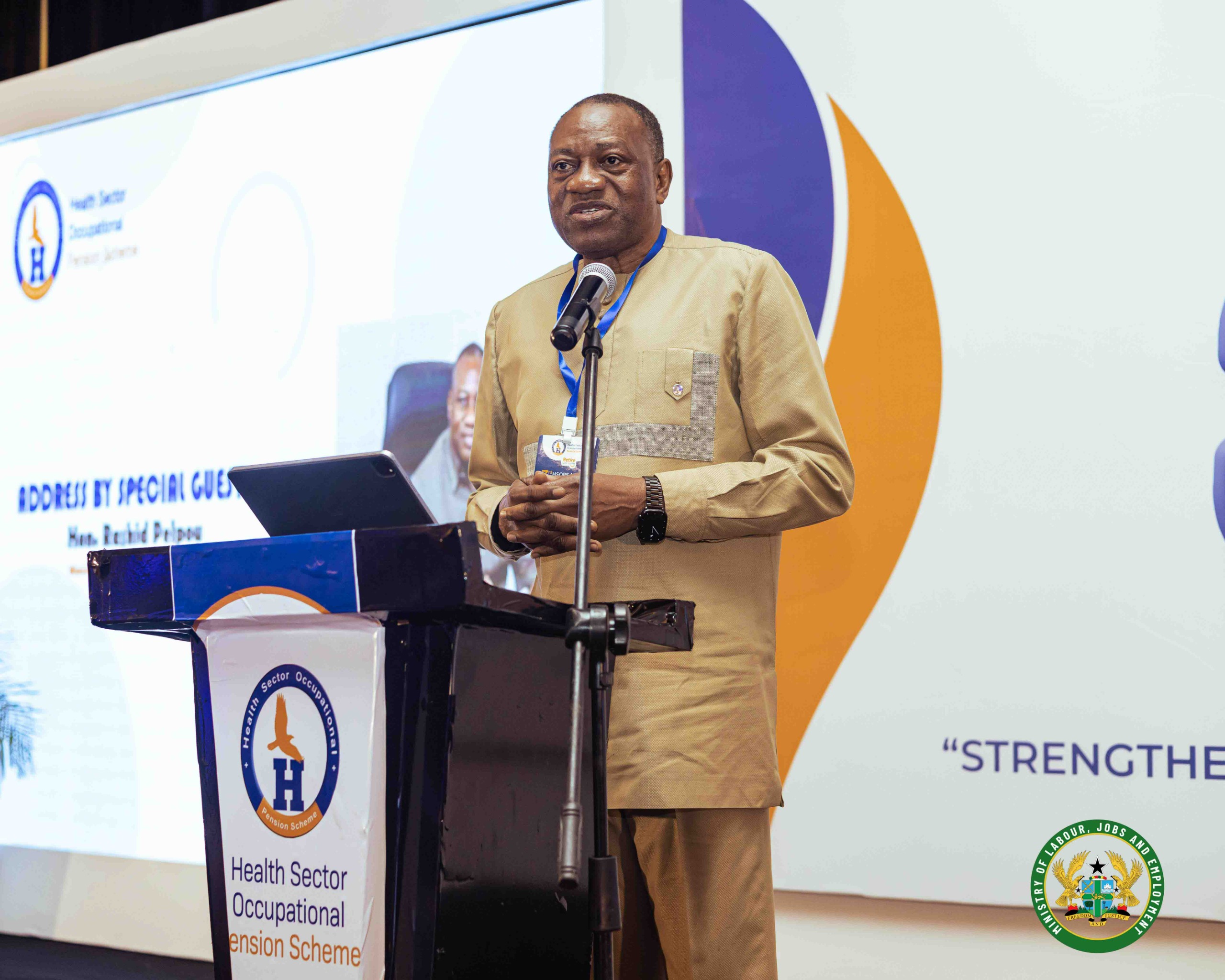
The Minister for Labour, Jobs and Employment, Dr Abdul-Rashid Hassan Pelpuo, said this at the 3rd Annual General Meeting of the Health Sector Occupational Pension Scheme (HSOPS) held last Wednesday in Accra.
He expressed concern over delayed remittances of workers’ contributions by some employers, warning that such practices undermine investment performance and erode the value of pensions.
“We must intensify efforts to enforce compliance and address the issue of delayed remittance by employers, as these delays directly impede the investment process and erode the value of workers’ contributions,” he said.
Dr Pelpuo noted that dignified retirement remains key to enhancing productivity and sustaining national development.
He commended HSOPS for its prudent management and consistent progress, describing it as a model for ensuring long-term financial stability for the country’s health sector workforce.
He emphasised that pensions are not merely end-of-service benefits but a critical pillar of Ghana’s social and economic stability.
On his part, the Chairman of the HSOPS Board of Trustees, Derek Amoateng, disclosed that the scheme now has over 230,000 members across the country.
He explained that under the theme “Strengthening Ghana’s Pension Ecosystem for Development and Retirement Security,” this year’s AGM seeks to reinforce the importance of building a resilient and inclusive pension system that guarantees financial stability for all health sector workers.
Dr Amoateng reported that despite earlier economic challenges, HSOPS achieved remarkable results in 2024, with gross investment income rising to GH¢889 million, representing a 28.2% return compared to a benchmark of 25.8%.
The scheme’s total assets under management also increased by 30%, reaching GH¢5.14 billion, making it one of the largest occupational pension schemes in the country. He attributed the strong performance to sound investment diversification, improved governance, and greater operational efficiency, including a reduction in benefit processing time from 54 to 33 days.
The Chief Executive Officer of Dalex Finance, Mr Joe Jackson, called for bold reforms in Ghana’s pension system to ensure broader coverage, sustainability, and trust, especially among informal sector workers.
Mr Jackson noted that only a small fraction of Ghana’s workforce, about twelve per cent, was currently covered by formal pension schemes, leaving the vast majority of informal sector workers unprotected.
He stressed that a strong and inclusive pension ecosystem was vital for national stability and must prioritise innovation, education, and technology to bring more Ghanaians into the retirement safety net.
He challenged trustees and regulators to diversify pension investments and reduce overreliance on government securities, describing the recent Domestic Debt Exchange Programme as a wake-up call for the industry.
“True safety lies in diversification,” he said. Adding that pension assets should be strategically directed toward productive sectors such as infrastructure, housing, and renewable energy to drive economic growth.
He further underscored the importance of trust and transparency, urging schemes to strengthen member engagement and communication. “There is a disconnect between what is happening at the top and what contributors feel. To build trust, members must know who manages their money and how it is being used,” he stated
Speaking on behalf of the Minister for Health, the Chief Director, Mr Desmond Boateng, described the scheme’s growth in assets and membership as a testament to sound governance and accountability, and urged the leadership to sustain the momentum through innovation and prudent investment management.
He highlighted several key policy initiatives under the government’s agenda to enhance motivation and service conditions in the health sector.
“These include the introduction of a 20% hardship allowance for health workers who accept postings to underserved communities, risk exposure insurance to protect against occupational hazards, and vehicle tax waivers to support professional mobility,” he said.
He noted that these interventions are designed to “restore morale, address inequality, and reward service and sacrifice.”
The Chief Director stressed that health workers deserve a dignified retirement beyond active service and that a strong and transparent pension ecosystem is essential to national stability.
Priscilla Osei-Wusu Nimako, ISD