President John Dramani Mahama has announced that government will pilot a pay for performance framework from January 2026.
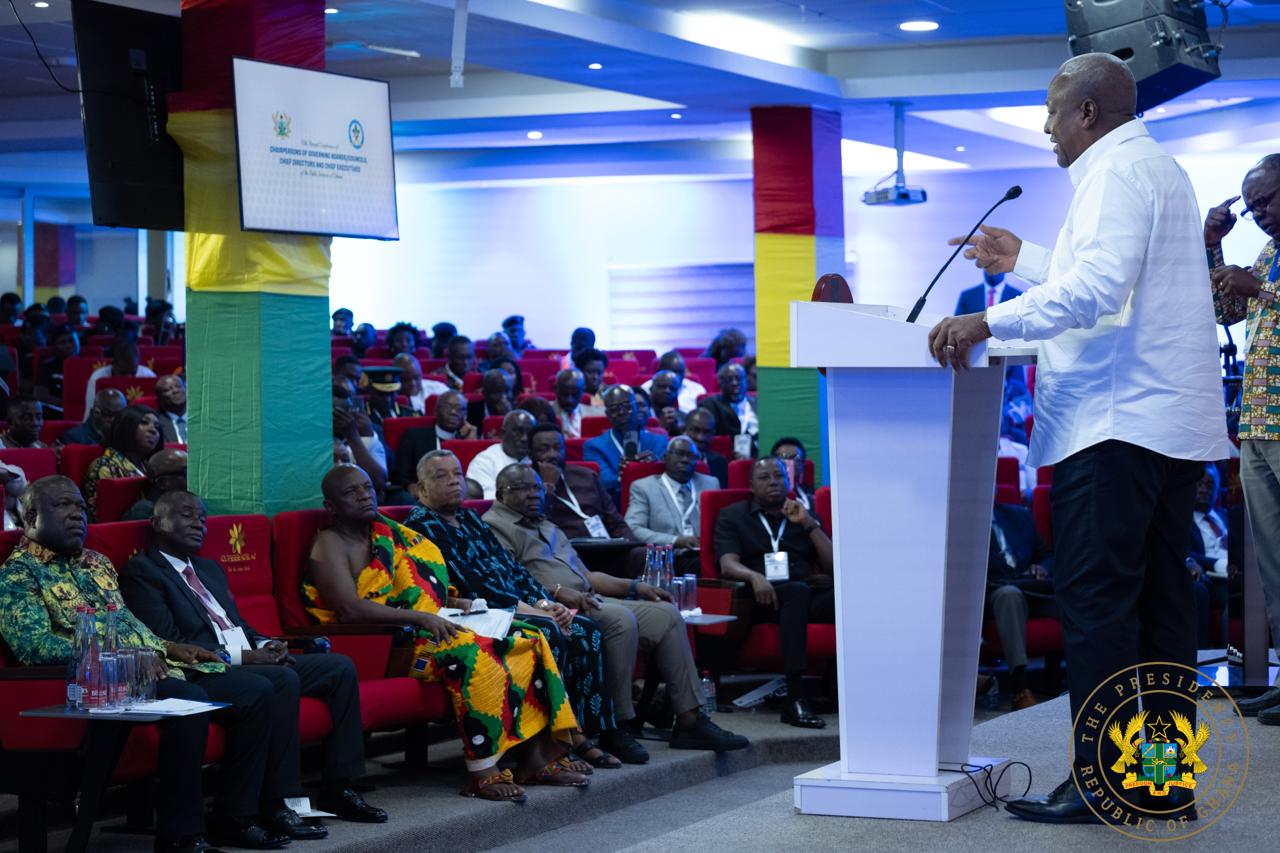
Speaking at the 12th Annual Conference of Chairpersons of Governing Boards and Councils, Chief Directors and Chief Executives of the Public Services of Ghana on Wednesday in Ho, President Mahama said the Ministry of Finance, the Fair Wages and Salaries Commission and the Public Service Commission have created the framework.
“To address this, the Ministry of Finance, the Fair Wages and Salaries Commission and the Public Service Commission have now created a pay for performance and productivity framework. And my hope is that this time this will work. Accordingly, I’m instructing these agencies to pilot the implementation of the framework, starting in January 2026,” he said.
He explained that the framework will address the weak link between productivity and reward in the current system.
“All over the world today, reward is associated with performance. But here, we have something we call a crossboard. A crossboard. So the lazy one gets, the hardworking one gets the same. And what it does is it deters the hardworking ones from giving off more than they can,” he stated.
President Mahama said the framework is a step towards institutionalizing a performance-driven culture.
“This is a crucial step towards institutionalizing a performance-driven culture that rewards diligence, information, and measurable outcomes in the public service,” he added.
He recalled that in 2015 the Public Service Commission introduced the Performance Management System to enhance accountability but its implementation has encountered challenges.
“In 2015, the Public Service Commission, in collaboration with the Fair Wages and Salaries Commission and the Central Management Agencies, introduced the Performance Management System, the PMS, to enhance accountability and deliver better services. Although this system represented a vital reform, its implementation has encountered ongoing challenges, especially the weak link between productivity and reward,” he said.
The President shared an experience when he was minister about an attempt to introduce a clocking system.
“I remember when I was minister, we had a first attempt, one of the multilateral institutions made a first attempt, in collaboration with government, to do a pilot to put in a clocking system. We selected one ministry to start. There was almost a strike. Because it was linked to the accountant general. So when you came, you had to put your biometric and clocking. And then it will register that you came at this time. When you close, you clock out. And then at the end of the month, it will publish how many, how long you were at work behind your desk and all that. There was almost a strike. We had to back down,” he stated.
He emphasized the need to develop the right attitudes and culture in the public service.
“But in the 21st century, I mean, why did you come to work? No one will say it’s your fault. And yet we go abroad and it can be a slowing, a thunderstorm after you are at work. You know, we need to develop the same attitudes and culture here,” he said.
The President also ordered all public service institutions to be integrated into the Human Resource Management Information System.
“I’m instructing all public service institutions, whether subverted or not subvented, to be fully integrated into the human resource management information system. This integration will establish the HRMIS as the single authoritative source of personnel data, ensuring accountability, transparency and efficiency in human resource management across our entire public sector,” he said.
He expressed concern that government does not have a centralized personnel database in the 21st century.
“One of the persistent challenges in Ghana’s public administration is a lack of a centralized, integrated personnel database. This system thoroughly records recruitments, promotions, remunerations and retirement processes across the public service. And I mean, you can’t understand why in the 21st century government does not have a proper database of people that he employs,” he stated.
President Mahama noted that the current fragmentation has caused inefficiencies and data inconsistencies.
“This fragmentation has caused inefficiencies, data inconsistencies and reduced oversight. It’s also part of the reason why it goes, you know, come out of their briefs and come and take money from our accountant general’s department,” he said.
He added that the integration will address issues of nurses and teachers going unpaid for months.
“And so nurses and teachers have to sit for God knows how many months unpaid until some slow bureaucratic process goes from the district to the region, from the region to the headquarters, to Ministry of Finance, to Auditor General. Please, we need an HRMIS as soon as possible,” he stated.
Richard Aniagyei, ISD