Ghana Launches West Africa Sustainable Ocean Programme to Strengthen Regional Marine Governance
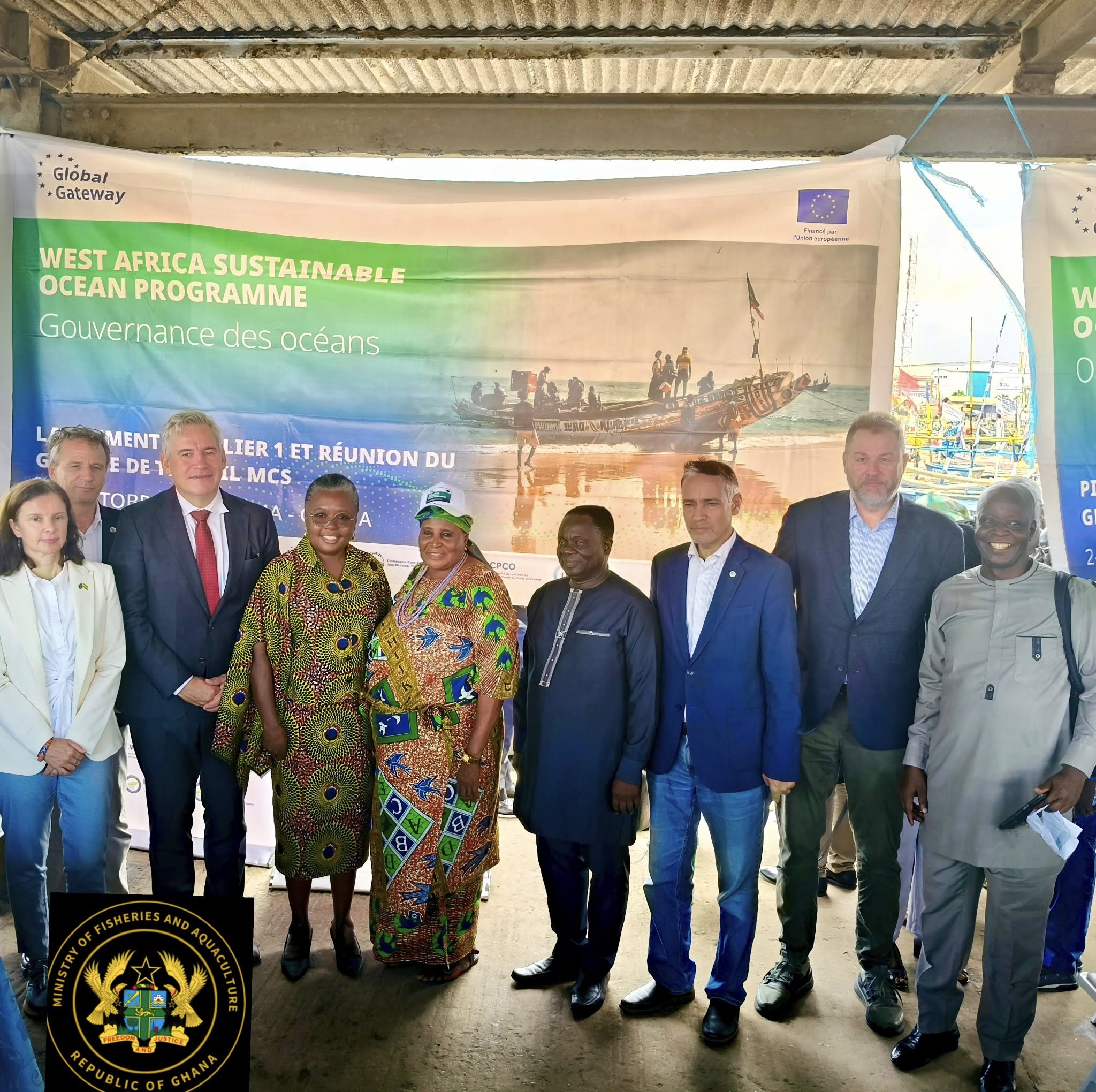
Ghana has officially launched the West Africa Sustainable Ocean Programme (WASOP), a pioneering regional initiative aimed at enhancing ocean governance, promoting a sustainable blue economy, and protecting marine ecosystems across 13 coastal West African nations.
Speaking at the launch event on Thursday in Tema, the Minister for Fisheries and Aquaculture, Mrs Emelia Arthur, described the initiative as “a defining moment in our collective journey to secure the health of our oceans, strengthen the resilience of our fisheries, and safeguard the prosperity of our coastal communities.”
She expressed deep appreciation to the European Union for funding the programme and selecting Ghana as a key partner in its implementation.
The Minister explained that WASOP is anchored on three main pillars: strengthening ocean governance, reducing illegal, unreported, and unregulated (IUU) fishing through science-based management of shared fish stocks, and enhancing regional cooperation.
“Supporting a sustainable blue economy, unlocking new economic opportunities while ensuring inclusivity and climate resilience, as well as protecting and restoring marine and coastal ecosystems, safeguarding biodiversity, and strengthening livelihoods in coastal communities, constitute another core pillar,” she added.
She further noted that the initiative aligns closely with Ghana’s Fisheries and Aquaculture Act, 2025 (Act 1146) and the National Blue Economy Agenda, which together provide the legal and policy frameworks for harnessing Ghana’s ocean and freshwater resources for sustainable growth.
Mrs Arthur underscored the need for collective action and innovation, calling on governments, fishers’ associations, civil society, and the media to play their part.
“Our fishers and coastal communities are not just beneficiaries, they are true partners in this journey. Their active engagement will ensure that WASOP remains locally grounded and regionally owned,” she emphasised.
The European Union Ambassador to Ghana, H.E. Rune Skinnebach, emphasised the urgency of addressing IUU fishing, which deprives West Africa of billions of dollars annually and threatens food security and jobs.
He reaffirmed the EU’s commitment to supporting the region, stressing that “the ocean is our common heritage, and its health is our shared responsibility.”
The programme, coordinated by Expertise France, with implementation support from EFCA, FAO, SRFC/CSRP, and FCWC, covers 13 coastal West African states: Benin, Cabo Verde, Côte d’Ivoire, The Gambia, Ghana, Guinea, Guinea-Bissau, Liberia, Mauritania, Nigeria, Senegal, Sierra Leone, and Togo.
Judith Twumwaa, ISD