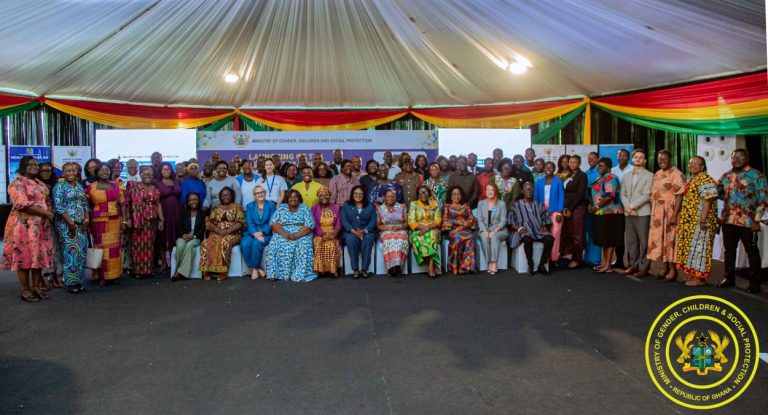
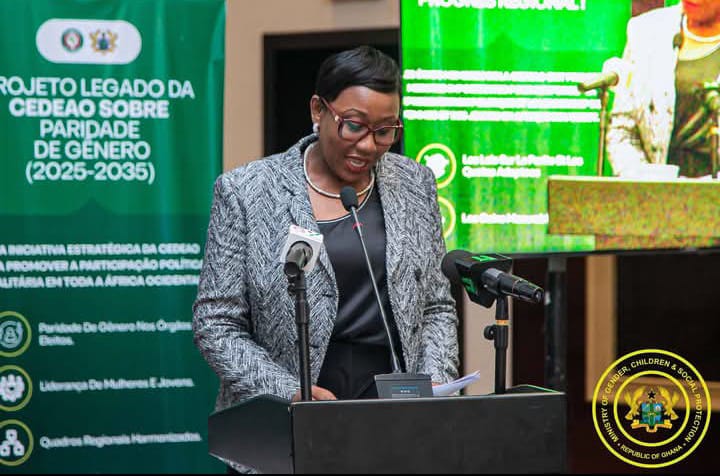
The Vice-President of the ECOWAS Commission, Madam Damtien Tchintchibidja, has called on West African ministers to seize a generational opportunity to transform political inclusion across the region, unveiling a legacy project to establish sustainable mechanisms for women’s and youth participation in governance.
Speaking at the Ministerial Meeting on the margins of the Regional Consultation on Political Participation and Leadership of Women and Young People in Accra, she described the initiative as a framework to be shaped by national ministers rather than a regional directive to be imposed upon member states.
“This legacy project is not a regional initiative to simply be implemented by member states. It is a framework for shaping and championing. As ministers responsible for gender equality, social inclusion, and human development at the national level, you are not mere stakeholders; you are its architects,” she said.
She noted that the project will be anchored in a presidential political declaration carried forward by the momentum of ECOWAS’s 50th anniversary, complemented by co-created regional guidelines designed to support the adoption of appropriate legal and policy frameworks at the national level.
She stated that these instruments are intended to reinforce, not replace, national ownership by providing shared direction while respecting the contextual specificities of each member state’s political and institutional landscape.
The initiative comes as ECOWAS takes stock of its 50-year journey, positioning itself for greater impact in alignment with Vision 2050, which places people-centred development, human capital, inclusion, and resilience at the heart of regional integration.
“At a time when heads of states and governments are shaping the future of regional integration, this project places women and youth at the centre of national development strategies, directly linking political inclusion to employment, stability, democratic legitimacy, and long-term prosperity,” the official said.
The framework aims to provide collective political leverage to advance reforms that are often challenging to pursue in isolation. It establishes a shared regional framework to inform governmental deliberations, enrich parliamentary dialogue, and guide budgetary prioritisation while strengthening national efforts through regional solidarity and peer exchange.
Madam Tchintchibidja addressed ministers directly, framing the moment as a choice with profound implications.
“Today we are called upon to make a choice that is both political and generational: to invest in durable institutions, in leadership that reflects the diversity and strength of our societies, and in a region that leaves no one behind.
History will remember this generation of leaders not for what we said but for what we enabled. With your leadership, this legacy project can become a turning point where our region chooses inclusion not as an aspiration but as a defining commitment to its future,” she said.
She stated that the presidential political declaration and regional guidelines are designed as tools at the service of ministers to transform national priorities into sustained political commitments and measurable outcomes, bringing coherence where fragmentation exists and continuity where political cycles are short.
“Let it be said that in this moment we chose courage over caution, partnership over hesitation, and progress over delay, and let this generation be remembered as the one that widened the space of leadership, strengthened the pillars of opportunity, and ensured that the full potential of women became a driving force of our region’s transformation,” she added.
On her part, the President of the ECOWAS Association of Female Parliamentarians (ECOFEPA), Madam Chantal Fanny Moussokoura, stated that democracy in the sub-region cannot succeed if women remain marginalised from political leadership.
She noted that excluding women and young people from governance weakens institutions and undermines sustainable development.
“No democracy can thrive when half of its citizens are excluded, describing the Accra meeting as a decisive moment for regional action rather than rhetoric,” she said.
Senator Moussokoura further advocated bold interventions, including gender quotas, affirmative action policies, and reforms to electoral systems to address historical imbalances.
She also highlighted the need for expanded civic education, mentorship programmes, and digital tools to empower emerging young leaders.
Grace Acheampong, ISD