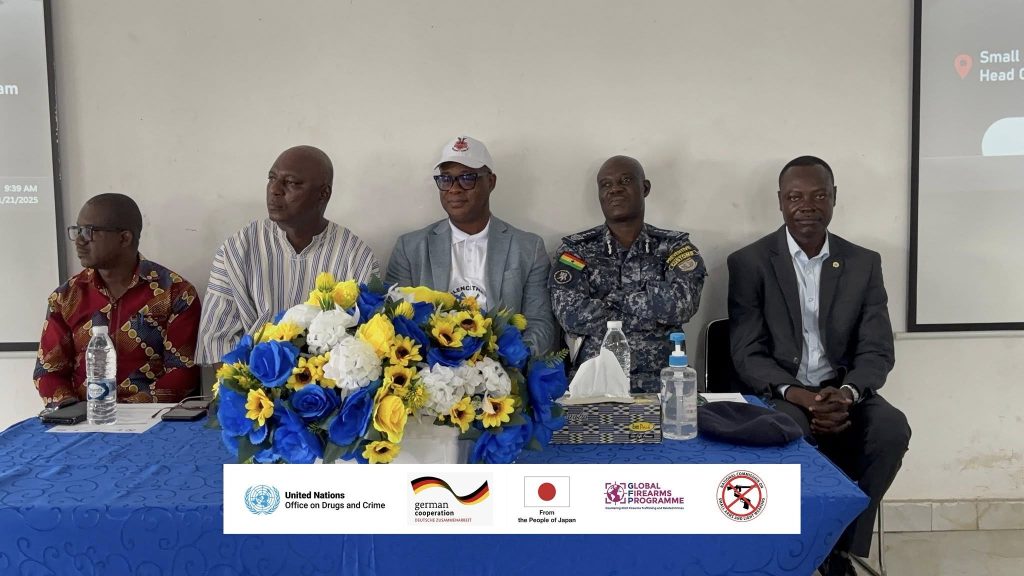
The National Commission on Small Arms and Light Weapons (NACSA), in collaboration with key national security and law enforcement institutions, has organized a national training programme in preparation for Operation KAFO VI.
This is a major cross-border initiative aimed at combating illegal firearms trafficking and related security threats within the ECOWAS region.
Operation KAFO VI is supported by the United Nations Office on Drugs and Crime (UNODC), GIZ, the Government of Japan, and the UNODC Global Firearms Programme.
Speaking at the opening ceremony on Friday in Accra, the Executive Secretary of NACSA, Dr. Adam Bonaa, said the operations would target Ghana’s entry and exit points to strengthen prevention, combating, and eradicating the trafficking of arms, ammunition, explosives, drugs, and other contraband.
He emphasized that the success of the initiative relies heavily on the competence, vigilance, and collaboration of frontline security personnel, making the KAFO VI training an essential intervention.
“The proliferation of small arms remains one of Ghana’s most complex security challenges, fuelling violent crime, enabling organized networks, and threatening the country’s peace and stability,” he said.
Dr. Bonaa noted that, the training aims to strengthen existing efforts by equipping officers with advanced skills in arms detection and identification, surveillance and monitoring, interception procedures, as well as intelligence sharing and inter-agency coordination.
He commended the participants for their dedication and encouraged them to actively engage in the programme, share knowledge, and build the teamwork required for effective operations in the field and acknowledged the support of partner agencies whose sustained collaboration continues to make national security interventions such as Operation KAFO VI possible.
Dr. Bonaa reaffirmed NACSA’s commitment to working with national and regional partners to combat the trafficking of small arms, ammunition, explosives, drugs, and other contraband that threaten public safety and national development.
He urged the public and traditional authorities to cooperate with the initiative, emphasising that collective efforts were critical to ensuring Ghana’s borders remain safe and secure.
The training brought together 32 frontline officers from 14 national institutions, including the Customs Division, INTERPOL, Immigration Service, Armed Forces, NACOC, EOCO, NIB, GCAA, GPHA, the Fisheries Commission, and the Attorney General’s Office.
Judith Twumwaa, ISD