
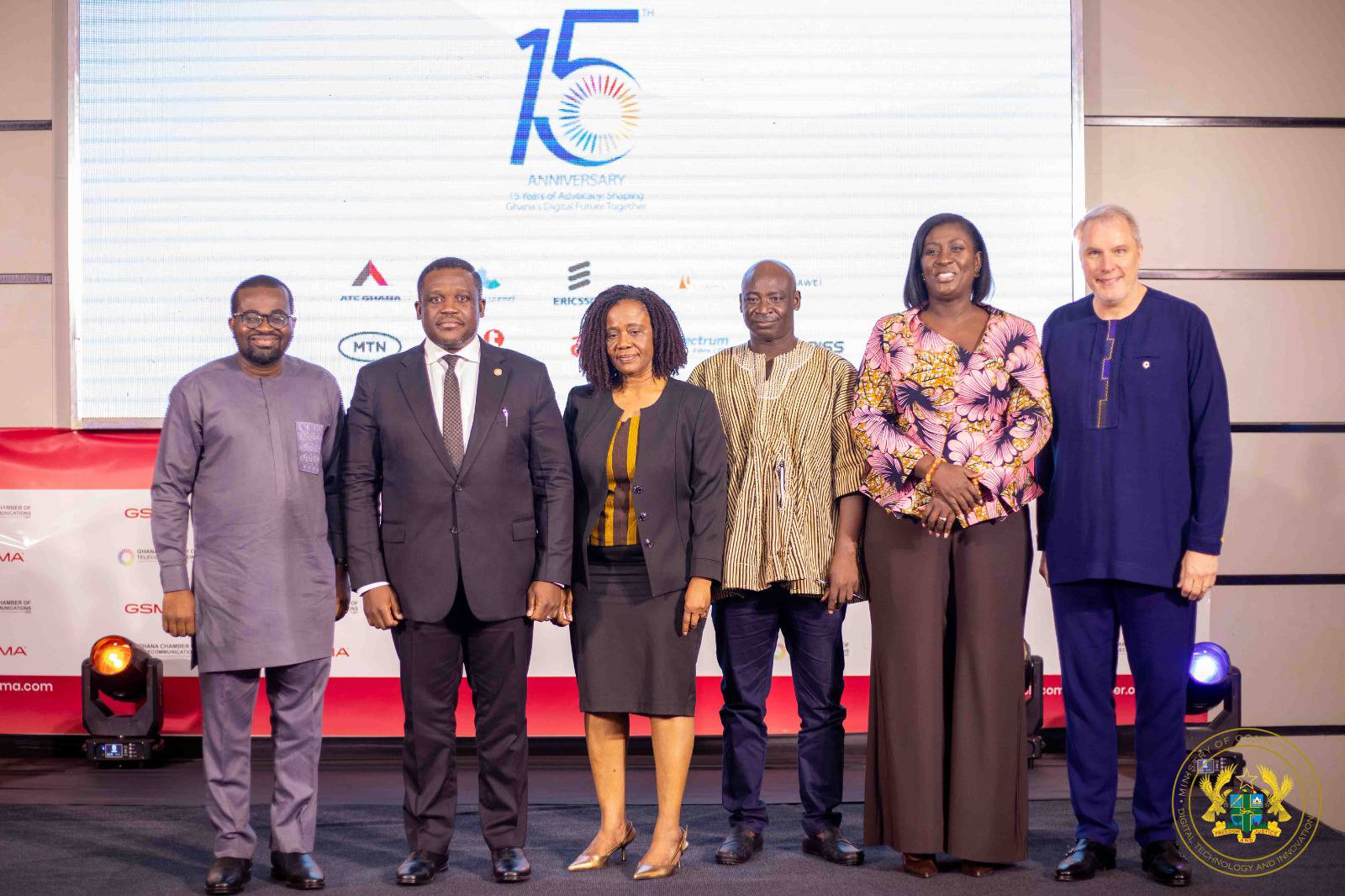
The Minister for Communication, Digital Technology, and Innovations, Samuel Nartey George, has called on stakeholders in the telecommunications industry to adopt a balanced and investment-friendly approach to spectrum pricing to support Ghana’s ambitious 5G rollout agenda.
According to the Minister, spectrum allocation decisions must prioritise national development, digital inclusion, and affordable connectivity while ensuring that telecom operators remain capable of making long-term investments in infrastructure.
Speaking on Wednesday at the 15th anniversary celebration of the Ghana Chamber of Telecommunications and a high-level workshop on spectrum auction strategy in Accra, Mr George stressed that spectrum remains a finite national resource that must be managed strategically for the benefit of citizens.
He disclosed that the government is targeting 70 per cent 5G population coverage by March 2027, warning that excessive spectrum pricing could undermine the investments required to achieve that objective.
“We must avoid pricing models that choke the very investment needed to deploy 5G infrastructure,” he stated.
Mr George announced that the Cabinet has approved a transition toward a competitive national spectrum auction framework while maintaining a wholesale model intended to encourage broader participation in next-generation digital services.
According to him, stakeholders are expected to deliver concrete policy and technical recommendations within 30 days for consideration and implementation by the National Communications Authority.
The Minister urged industry players to adopt forward-looking strategies by interrogating available data, challenging outdated assumptions, and proposing practical models capable of supporting Ghana’s digital ambitions.
The Minister emphasised that decisions taken during the workshop would have lasting implications for Ghana’s digital economy and called for unity and urgency in building a spectrum regime that benefits investors, innovators, and the wider population.
The Chief Executive Officer of the Ghana Chamber of Telecommunications, Sylvia Owusu-Ankomah, noted that decisions surrounding spectrum policy would significantly influence Ghana’s digital competitiveness, investment climate, and quality of digital services in the coming years.
She described spectrum management as central to the delivery of reliable digital services and urged stakeholders to approach the discussions as a national development issue rather than a purely technical exercise.
Madam Owusu-Ankomah also disclosed that the Chamber is undertaking measures to reposition and rebrand itself to reflect the country’s evolving digital ecosystem while supporting transparent policymaking and stronger industry collaboration as the government pursues major legal reforms in the sector.
Judith Twumwaa, ISD